Best Aquarium Heater for Planted Tanks
Best aquarium heater for planted tanks by tank size: wattage math, Fluval E100 vs E50, and safe placement that shields plants and shrimp.
Table of Contents
Affiliate Disclosure: We may earn a commission if you purchase through our links. This does not change the price you pay. How the desk is funded: How We Make Money.
This is a research-based guide, not a hands-on test. We compare manufacturer specifications, current US retail listings, and the patterns that show up in published owner reports. We do not invent lab PAR maps, credentials, or prices. Amazon product links on this page use the Associates tag plantedtankreviews-20. You do not pay more when you use them. Retail prices move; we hedge dollar talk on purpose and tell you to check the live listing. Scope is freshwater planted-tank hardware. We do not stock livestock, review live plants as products, diagnose disease, or recommend medications.
US search interest for aquarium heater is enormous. The planted-tank version of that query is smaller and more specific: a tube that will not cook a soil bed, will not hide behind wood until it fails, and will not drag this page into ich or medication folklore. We stay on placement, wattage bands, and a named electronic SKU we can verify.
If you are still choosing filtration, read best filter for a planted tank and Fluval 107 vs AquaClear 50 so you know where the flow actually is. A heater in a dead corner is a stuck-on risk. A later lily-pipe set moves that current — re-place the tube, do not clip it to the stem. Lights and a 20-gallon stack live in best planted tank lights 2026 and best light and filter for a 20-gallon planted tank. The named light fight is Fluval Plant 3.0 vs Chihiros vs Twinstar.
What a planted heater has to do
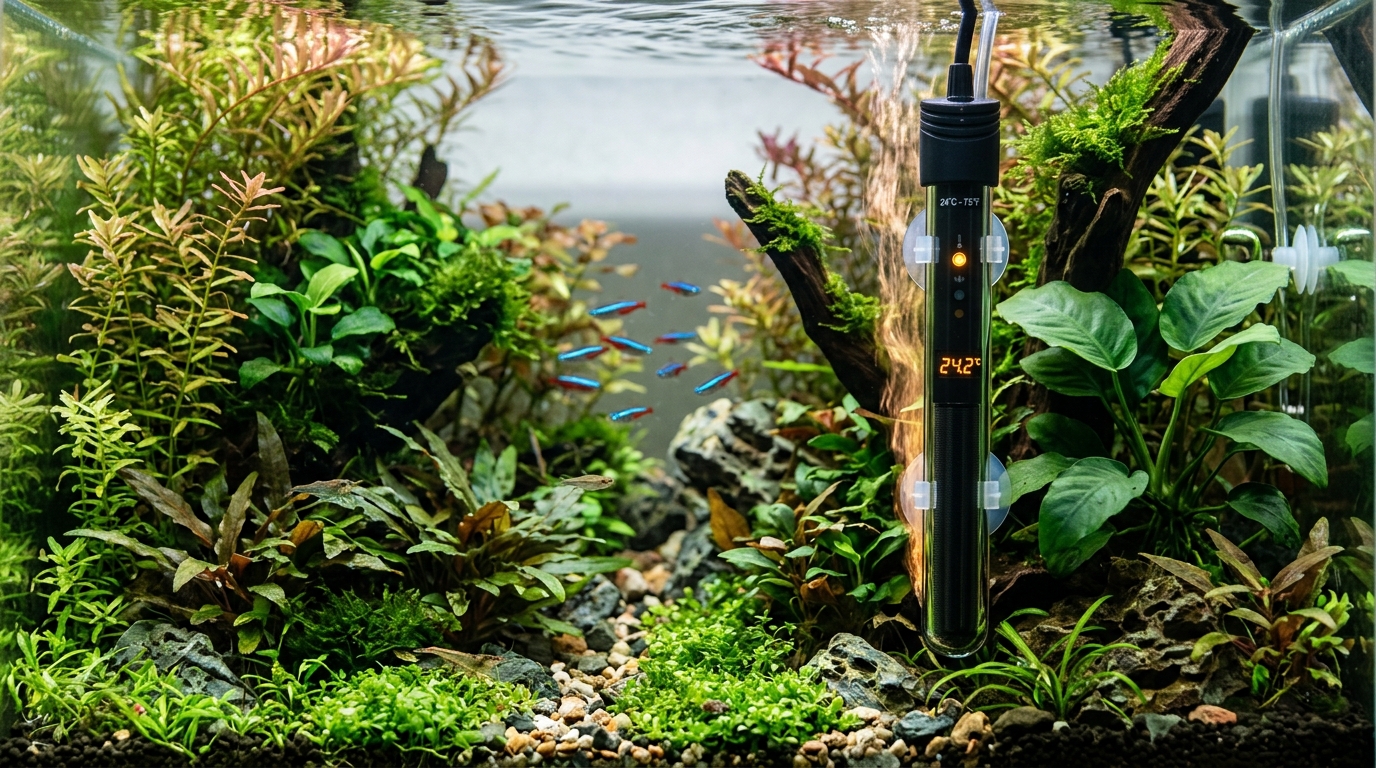
A heater is a resistor in a glass or quartz tube with a thermostat. It has three jobs:
- Add heat when the room is colder than the water target.
- Stop adding heat when the probe or bimetal says it is enough.
- Stay inspectable so a stuck-on failure is visible before the tank becomes a hot tub.
It does not fertilize plants. It does not treat disease. It does not replace a filter or a light. If your room already holds a stable comfortable indoor temperature, you may need less wattage than a garage-tank article assumes. If your room swings, you need a correctly sized tube and a second thermometer, not a forum protocol.
Planted-safe placement is the difference between this page and a generic heater list: keep the tube out of aquasoil, out of Flourite piles, and out of wood pockets. Active soils and clay beds are covered in best substrate for a planted tank. Burying a heater in either is how people crack glass and cook a corner.
How we compared heaters
We scored heaters on:
- Readability. A printed analog scale versus a digital display you can see without pulling the tube.
- Size band. Whether a current US listing exists in the 100-watt class that matches 10–20 gallon planted tanks.
- Placement honesty. Fully submersible, minimum water line marked, bracket that can sit behind hardscape without becoming invisible.
- Failure humility. Electronic heaters still fail. A second thermometer is not optional.
We did not invent degree-by-degree livestock targets. We did not publish street prices. Electronic 100-watt tubes often live well below a mid-tier light. Check the live listing.
Fluval E100 as the named electronic pick
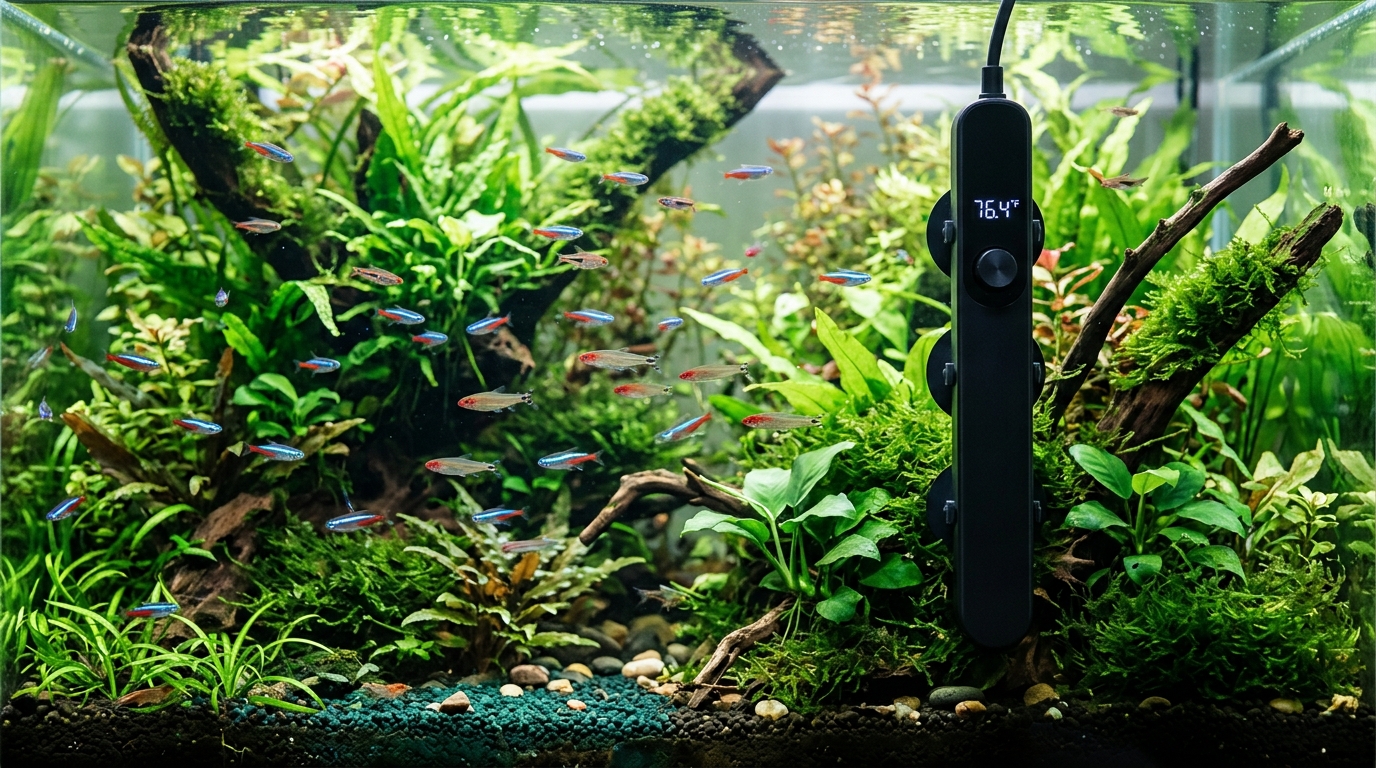
The Fluval E100 (B001VMWT4Q) is the named heater in this pillar. Fluval's E-series listing describes a 100-watt electronic heater for tanks up to 30 US gallons, with a VueTech display and control in half-degree increments. That wattage class matches 10-gallon and 20-gallon planted volumes without jumping to a 200-watt or 300-watt tube.
What you are buying is a readable display and a slim body that can sit in flow behind a wood piece — behind, not inside. The display is why we prefer a named electronic SKU over a mystery stick whose printed numbers wear off.
Where the E100 loses: it costs more than a basic analog tube. Electronics still stick. You still need a second thermometer. You still must keep the minimum water line above the mark during a water change.
The E100 is the right default when you want to glance at a number and you are in the 10–30 gallon band. It is the wrong default when the tank is a 75-gallon and you need a pair of larger tubes — buy the matching wattage, do not parallel two guesses.
Fluval E100 Advanced Electronic Heater
Fluval
100W electronic Fluval E-series heater for tanks up to 30 US gallons, with VueTech display and 0.5-degree increment control.
Before you click. The E100 card is a 100-watt electronic tube. Marketplace rows still sell a 50-watt or 300-watt sibling with a reused VueTech photo. Confirm "E100" and 100W in the live title, and that the gallon band still says up to 30 US gallons. A second thermometer is not in that box — buy one separately. This desk is not logging a tank diary; it is telling you what the listing usually omits.
Buying notes the listing will not write
Fluval's E-series copy still talks about tropical livestock comfort. This page ignores that sentence. The hardware question is wattage class, a display you can read without pulling the tube, and whether you will see the minimum water line during a water change.
Replacement is usually the whole tube, not a spare heating element. If the display dies, you buy another heater. Plan a drip loop where the cord exits the rim so the brick is not sitting in splash. Cord length is a cabinet problem, not a brand personality.
An analog stick in the same 100-watt class is a valid buy if you already own a working one. Paying more for VueTech is a readability purchase. It is not a promise the relay will never stick.
Listing check
Heater listings lead with wattage and "fully submersible." Those words do not tell you whether the tube is still the electronic E-series body we named. Before you follow a plantedtankreviews-20 link on this page:
- Confirm the title still says Fluval E100 / 100W, not a 50-watt or 300-watt sibling in a reused photo.
- Confirm the VueTech-style display is in the current image set if that is the reason you picked electronic over analog.
- Confirm the gallon band on the live row still matches "up to 30 US gallons" for this SKU. A 75-gallon claim on a 100-watt tube is marketplace copy, not the printed band.
We do not paste Amazon "keeps tropical fish happy" language. This page is placement and wattage bands. A second thermometer is not in the box; buy one separately. If the listing swapped to an analog stick with no model number, skip it.
Analog sticks versus electronic displays
Analog heaters use a bimetal or similar mechanical thermostat and a printed scale. They are cheap. The scale is often optimistic. You set a number, then you believe a second thermometer, not the printed ink.
Electronic heaters use a probe and a display. They are easier to read. They are not immortal. A failed relay can still stick on or stick off. The display is a convenience, not a guarantee.
This site is not going to pretend one topology never fails. The planted-tank requirement is the same for both: flow around the tube, a second thermometer far from the heater, and a placement you will actually look at when you do a water change.
If you already own a working analog stick in the right wattage class, you do not need to "upgrade" for a scape photo. If you are buying new and you want a number you can read, the E100 is the SKU we can verify.
Wattage bands without treating them as laws
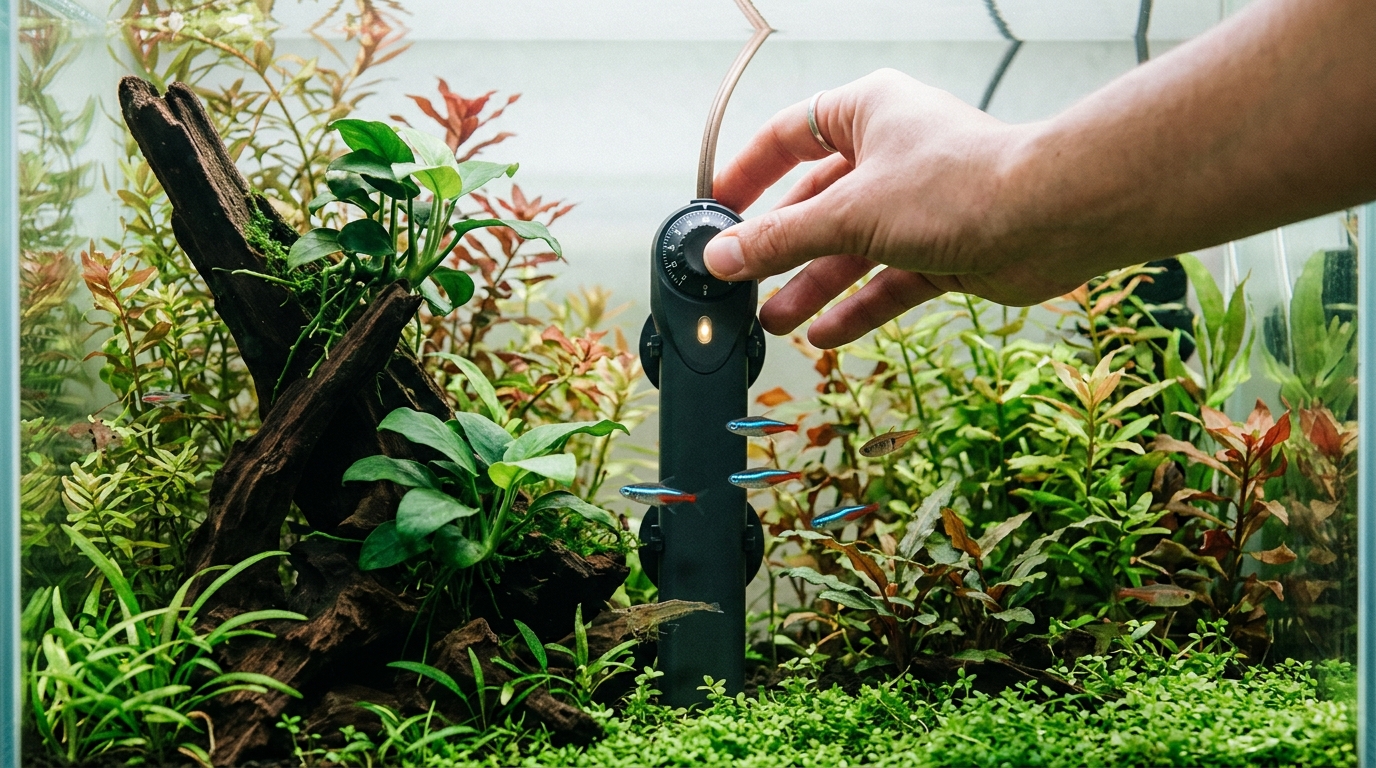
Manufacturers print aquarium-size ranges on the box. Those ranges assume a room that is not a garage in winter and not a sunroom in August. If your room sits near the target water temperature, you can often run the lower end of the wattage band. If the room swings, move up a band or add a controller rather than buying a giant heater "just in case." A giant heater in a small tank is a bigger single point of failure.
For many 10-gallon planted tanks, a 50-watt fully submersible unit is the catalog starting point. For many 20-gallon tanks, 100 watts is the catalog starting point. For 40-gallon and up, 150 to 200 watts appears often, sometimes as a pair of smaller units. Those are catalog bands, not a livestock survival plan.
Two smaller heaters can be smarter than one oversized tube on a long tank, because a single failure is a smaller swing. They are also two cords and two places to inspect. Choose the complexity you will live with.
We will not publish a "watts per gallon" slogan as if rooms did not exist. Measure the room. Then buy the band.
When to skip the tube
A heater is room-correction hardware. Skip the cart when overnight room temperature, in winter, already holds a range you accept. Measure the room. A July afternoon is not a measurement.
Skip a giant 200-watt or 300-watt tube on a 10–20 gallon planted tank "for later." A giant heater in a small tank is a bigger single point of failure. The E100-class 100-watt band is the catalog start for many 20s. Two smaller tubes on a long tank are a complexity choice, not a reason to oversize one stick.
Skip burying the tube to "warm the roots." Heat is not a substrate product. The granules stay a planting bed. The resistor stays in open water.
10, 20-high, and 20-long are different lanes
Wattage bands assume a box. Planted tanks are rectangles.
| Tank | Catalog starting band | Placement that actually matters |
|---|---|---|
| 10-gallon cube or rectangle | 50-watt class in an ordinary room | Short glass. Visible. Off the soil. |
| 20-gallon high (~24 × 12 × 16) | 100-watt / E100 class | Opposite an AquaClear 50 waterfall, or in the Fluval 107 spray-bar lane. |
| 20-gallon long (~30 inch) | Same 100-watt class, or two smaller tubes if the far end stays cold | Long water column. One tube at one end can leave a cool far glass. A second thermometer answers this. |
The 20-gallon shopping order picks the light length first — 22W on a 20-high, 32W on a 20-long. It does not pick a different heater SKU for high versus long. Same E100-class tube. Different lane. Do not buy a 300-watt sibling because the tank is "long."
Lily pipes, spray bars, and the heater lane
Filter personality decides where the current is. The tube belongs in that current.
- AquaClear 50: the waterfall already moves one end. Place the heater mid-glass or opposite the weir, not stuffed in the box. The two-SKU fight is Fluval 107 vs AquaClear 50.
- Fluval 107 stock spray bar: aim the bar along the rear glass. Sit the heater in that lane.
- Later lily-pipe set: the return moves. The old eddy behind wood may become the new still corner. Re-place the tube after you change the outflow. Do not tape it to the glass or PETG stem. Hose sizing lives on best lily pipe for a planted tank. A 17 mm / 16/22 mm set on a 107 does not include a heater clip, and it should not.
A CO2 ceramic disc also wants that lane. Heater plus disc on the same suction-cup forest is how cups let go. Leave a channel.
LED intensity is a different rail. A wide-open WRGB II does not replace a correctly sized tube in a cold room, and a Plant 3.0 photoperiod does not belong on the heater plug. See Fluval Plant 3.0 vs Chihiros vs Twinstar for the bar. Keep this page on the resistor.
Planted-safe placement
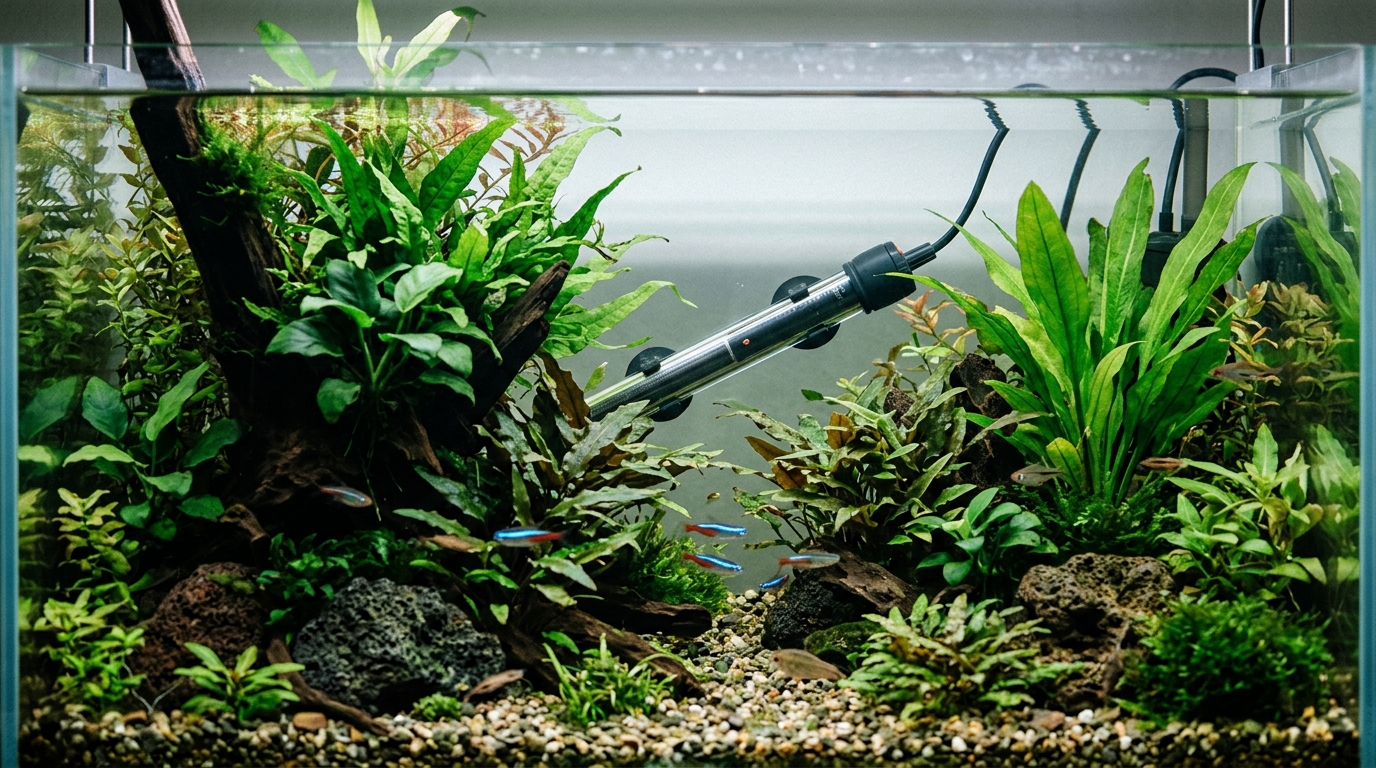
Driftwood and rock create pockets. A heater pressed into a pocket can overheat locally and underheat the open water. Leave a water channel around the tube. If you use a protective guard, confirm it still allows flow. Guards are useful near curious hardware-rearrangement (you moving wood), not as a substitute for clearance.
Do not bury a heater in aquasoil. Do not wedge it under a slate pile. Do not hide it so well you forget it exists during a water change. Visibility is a feature. Active soils and clay beds are covered in best substrate for a planted tank — the tube stays in the water column, not in the bag.
Suction cups fail. When a cup pops, the tube can tilt into the sand line or rest on glass. Check cups when you rinse filter media. That is the same maintenance visit, not a second hobby.
On a hang-on-back tank, the waterfall already moves the surface. Place the heater on the opposite end or in the mid-glass current so you are not heating only the weir. On a Fluval 107 tank, aim the spray bar so the heater sits in the lane, not in the eddy behind a wood wall.
Controllers, probes, and why two readouts help
A heater with a built-in dial is one sensor. A controller with a separate probe is a second sensor. Using both is not paranoia. It is how you notice a stuck relay before the tank becomes a hot tub. Place the probe away from the heater body. If the probe sits on the heater, the controller thinks the world is warmer than the far side of the tank.
Battery or USB thermometer strips on the glass are cheap cross-checks. They are not laboratory gear. They are "is the dial lying?" gear. Calibrate your expectations: cheap strips can be off by a degree. You are looking for sudden jumps, not tenths.
Inkbird-style controllers exist as a product class. We are not inventing an ASIN for a controller we did not verify in this pass. If you add one, it is a second thermostat in series or as a watchdog, not a reason to skip a correctly sized heater.
What to do after a water change
Heaters hate running dry. Unplug before you drop the water line below the minimum mark, or keep the water line above that mark while you work. When you refill, give the heater a few minutes in water before you restore power if the instructions say so. This is equipment protection, not a medical protocol.
If you use a canister filter, the heater can sit in the tank or, on some systems, in a hardware loop designed for it. In-tank is simpler to inspect. In-line is tidier and easier to forget. Choose the one you will actually look at.
Planted tanks get planted. That means you will reach into the tank. Unplug the heater if your hands will be near it for more than a quick stem pull. Wet hands plus a cracked tube is an electrical problem.
What this page will not do
We will not diagnose ich. We will not recommend medications. We will not publish a "raise the temperature to treat X" protocol. Those topics are YMYL and outside this site's scope. If you arrived from a disease query, this page will disappoint you on purpose.
We will not invent a livestock temperature as if every planted tank were a species tank. Plants have ranges. Rooms have ranges. Hardware either holds a stable number or it does not.
We will not list every analog stick on the market. Mystery glass tubes with no model number fail the same test lights fail: if you cannot search the SKU, you cannot replace it.
Heaters and the rest of the stack
A heater does not replace a filter. It does not replace a light. It does not replace CO2 or substrate. If you are building a 20-gallon, read the combined light and filter guide and the Fluval 107 vs AquaClear 50 comparison before you spend.
LED bars add a little heat. They are not a heater substitute in a cold room. Do not point a Chihiros-class bar at the water and call the heater optional unless you measured the room overnight.
CO2 solenoids and regulators do not heat the tank. Keep the cylinder and the heater from sharing a tangled power strip you cannot reach. Sketch the cabinet. The CO2 kit guide covers cylinder footprints.
Common placement mistakes
Heater horizontal on the substrate. Some tubes allow it; many planted beds do not want a hot line in the soil. Vertical in flow is the boring default.
Heater behind a solid rock wall. The display says one thing. The open water says another. Leave a channel.
No second thermometer. Then you are trusting a single failed part. Add a strip on the far glass.
Covering the display with wood "for the scape." Then you will not see a stuck-on error code or a blinking warning. Leave a viewing gap.
Using the heater as a hardscape stake. It is not a plant weight.
Failure modes the listing will not name
The analog-versus-electronic section says both topologies fail. This table names the failure so you know which part to unplug.
| Failure | What you actually see | Hardware move |
|---|---|---|
| Stuck-on relay | Far-glass thermometer jumps; the room did not | Unplug the tube. A calm VueTech display is not proof of innocence. |
| Stuck-off relay | Far glass falls overnight; the heater never clicks | Same unplug. Then a new tube in the same wattage class. Do not "fix" it with a 300-watt sibling. |
| Cracked glass or quartz | Hairline, drip at the cord, or a chip after a hardscape move | Unplug first. The tube is scrap. A guard that was already on is not a repair. |
| Suction-cup pop | Tube tilts into the substrate hill or rests on glass | Re-seat in flow. Replace the cups. Check them on filter-rinse day. |
| Dry-fire after a water change | Water line below the mark, plug still live | Unplug before the line drops. The 20-gallon stack already said the heater is its own switch. |
A cracked E100 is not a "reset the VueTech" problem. Buy another named 100-watt tube. We will not invent a spare-element ASIN.
Do not read a jumping thermometer as a livestock event. This page will not diagnose fish. It will tell you to pull the plug.
Day-one setup (no tank diary)
This is an unbox order, not a logged scape.
- Confirm the live title still says E100 / 100W, not a 50-watt or 300-watt sibling — same listing check.
- Buy the second thermometer the same day. It is not in the box.
- Place the tube in the current you already chose: opposite an AquaClear 50 waterfall, or in the Fluval 107 spray-bar lane. Details stay in lily pipes, spray bars, and the heater lane.
- Leave a channel. No soil. No wood pocket. No lily holster.
- Drip loop where the cord exits the rim. The brick is not a splash tray.
- Plug the heater into a reachable strip, not the light timer. Heat is a room problem.
- Write the far-glass number once. You are looking for later jumps, not tenths this desk invented.
Skip this ritual if you already skipped the tube because winter overnight air already holds — when to skip the tube.
A CO2 ceramic disc also wants that lane. Heater plus disc on the same suction-cup forest is how cups let go. Leave a channel. The 107 vs AquaClear 50 page still decides which current you are placing into.
When to skip the E100 (keep the heater idea)
When to skip the tube decides whether a resistor belongs on the cart. This section decides whether the named electronic SKU is the resistor.
| Situation | Skip the E100 | Buy instead |
|---|---|---|
| You already own a working analog stick in the 100-watt class | Paying for VueTech | Keep the analog. Add the second thermometer if it is missing. |
| Tank is a 75-gallon | This 30-gallon-class tube | Matching wattage, often a pair. Do not parallel two E100 guesses. |
| You refuse a second thermometer | Any electronic tube | Analog plus a strip, or stay out of the cart. The display is not a spare sensor. |
| Room already holds overnight in winter | The whole heater idea | Measure. A July afternoon is not a measurement. |
| You wanted titanium because a forum said glass is unsafe | This glass-class E100 | A named titanium model you can search. We will not invent that ASIN. |
Skip a used E100 with a bent bracket, a missing cup, or a seller who will not power the display on. A blank screen is a defect. This SKU is not a light; Bluetooth pairing is not the issue.
Quick Verdict
Rating: 8 / 10
The Fluval E100 is this guide's named electronic pick for 10-30 gallon planted tanks — a readable VueTech display and half-degree control instead of a mystery analog stick — scored against its own caveats: it costs more than analog, electronics still stick, and a second thermometer stays mandatory.
FAQ
Can I skip a heater in a warm apartment? Maybe, if overnight room temperature stays in a range you accept and you measured it in winter, not just in July. A cheap thermometer answers this. A forum vibe does not.
Is titanium better than glass? Titanium bodies exist and they are harder to break. We only affiliate-link SKUs we verified. The E100 is glass-class electronic hardware with a current ASIN. If you want titanium, buy a named model you can search — do not invent one here.
Should the heater match the light photoperiod? No. Heat is a room problem. Light is a photon problem. Do not put the heater on the LED timer.
What about heater guards sold for "curious fish"? This is not a livestock page. Guards are still useful so wood and tools do not smack the glass. Buy one if your scape is tight.
Can I mount the heater on a lily pipe? No. Re-place the tube in the new current after you change the outflow. The lily-pipe guide is hose diameter. This page is the resistor.
Does a 20-long need a different heater than a 20-high? Usually no. Same 100-watt class. Watch the far glass with a second thermometer. The 20-gallon stack changes the light length, not the heater SKU.
What does a stuck-on heater look like on the hardware? The second thermometer on the far glass jumps while the room did not. Unplug the tube. A stuck-off tube never clicks and the far glass falls overnight. Neither reading is a livestock protocol.
Do I replace the whole E100 if the display dies? Yes. Replacement is the tube. Confirm E100 / 100W on the new row. Keep the second thermometer. A blank display is not still a heater.
A closing checklist
- Measure the room overnight, not just at noon.
- Buy the wattage band that matches volume and room, not a giant tube for luck.
- Place the heater in flow, off the substrate, visible.
- Add a second thermometer on the far glass.
- Unplug when the water line will drop below the mark.
- Stay off disease threads.
That is planted-safe heat. Everything else is a different website.