Best Substrate for a Planted Tank
Fluval Stratum vs aquasoil vs Seachem Flourite for planted tanks. Hardware and chemistry, not livestock angles.
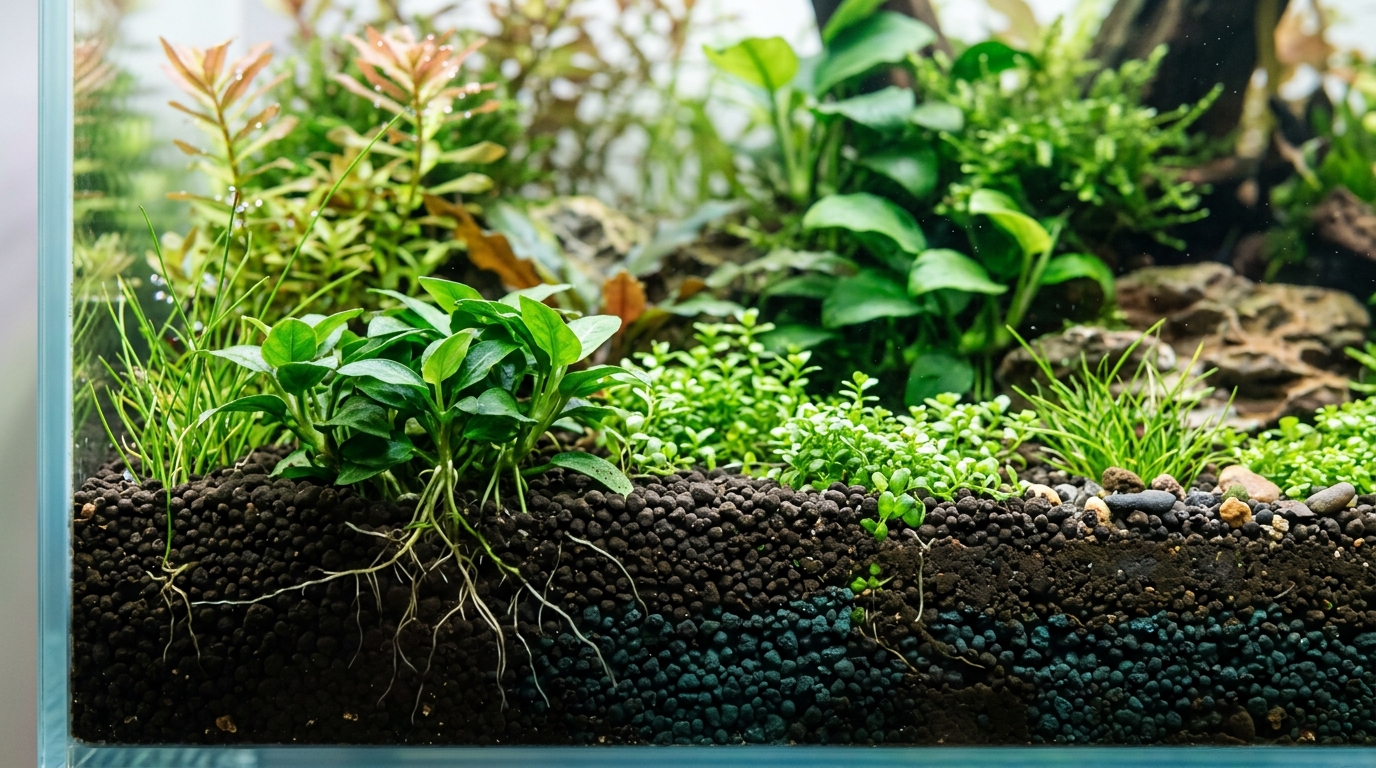
Table of Contents
Affiliate Disclosure: We may earn a commission if you purchase through our links. This does not change the price you pay. How the desk is funded: How We Make Money.
This is a research-based guide, not a hands-on test. We compare manufacturer specifications, current US retail listings, and the patterns that show up in published owner reports. We do not invent lab PAR maps, credentials, or prices. Amazon product links on this page use the Associates tag plantedtankreviews-20. You do not pay more when you use them. Retail prices move; we hedge dollar talk on purpose and tell you to check the live listing. Scope is freshwater planted-tank hardware. We do not stock livestock, review live plants as products, diagnose disease, or recommend medications.
Fluval stratum is one of the largest planted-hardware queries in US search. Best substrate for planted tank is the comparison query sitting next to it. This page answers both without turning into a livestock stocking article. No betta bowls, no goldfish gravel myths, no shrimp-breeding tangent. The hardware question is: active soil versus inert clay, and which named bags are actually for sale.
If you are still choosing light and filtration, start with planted tank lights and HOB vs canister. The named light fight is Fluval Plant 3.0 vs Chihiros vs Twinstar. A canister return that sandblasts this bed is a later lily-pipe problem, not a reason to buy a second bag. Substrate does not fix a six-hour noon blast or a filter aimed at the hill.
Three substrate families
Planted substrates sold in the US cluster into three families:
- Mild active soils — Fluval Stratum is the mass-market example. Porous volcanic granules, plantable, sold as a complete bed.
- Aquasoils — nutrient-charged baked soils (Tropica Aquarium Soil is the verifiable US SKU we use here; ADA Amazonia is the hobby shorthand). They typically soften water and need extra water changes after setup.
- Inert planted gravels — Seachem Flourite is the clay gravel that does not alter pH and is marketed as a life-of-the-aquarium bed.
Sand-only decorative beds and "aquarium gravel" dyed chips are not planted substrates. They hold plants poorly and contribute nothing to the root zone. Capping an active soil with sand is a technique some scapers graduate into later; it is not a fourth family, and this page treats it as a later decision, not a day-one move.
Published numbers at a glance
Most substrate roundups drown in invented density math. This page only treats manufacturer-published figures as data. Here is every hard number we lean on, in one place:
| Bag | Published figure | What it settles |
|---|---|---|
| Fluval Plant and Shrimp Stratum, 8.8 lb (model 12694) | Sold in 4.4 lb, 8.8 lb, and 17.6 lb bags | Which single bag plausibly covers a 10–20 gallon footprint at a modest depth |
| Tropica Aquarium Soil, 9 L | 2–3 mm grain; a 25–50 percent water change at least twice a week for the first four weeks | That the product includes a maintenance schedule, not just a bed |
| Seachem Flourite, 7 kg | About 7,000 cm³ / 425 cu in of planted volume; about 5 cm of depth in a typical 10-gallon; "good for the life of the aquarium" | Footprint math without guessing densities |
Everything else on this page — bag-count rules of thumb, "one bag per ten gallons" slogans, pound-for-pound comparisons across clay and volcanic soil — is marketing or a guess. Multiply your own glass. The source pages are linked in each product section below.
Fluval Stratum
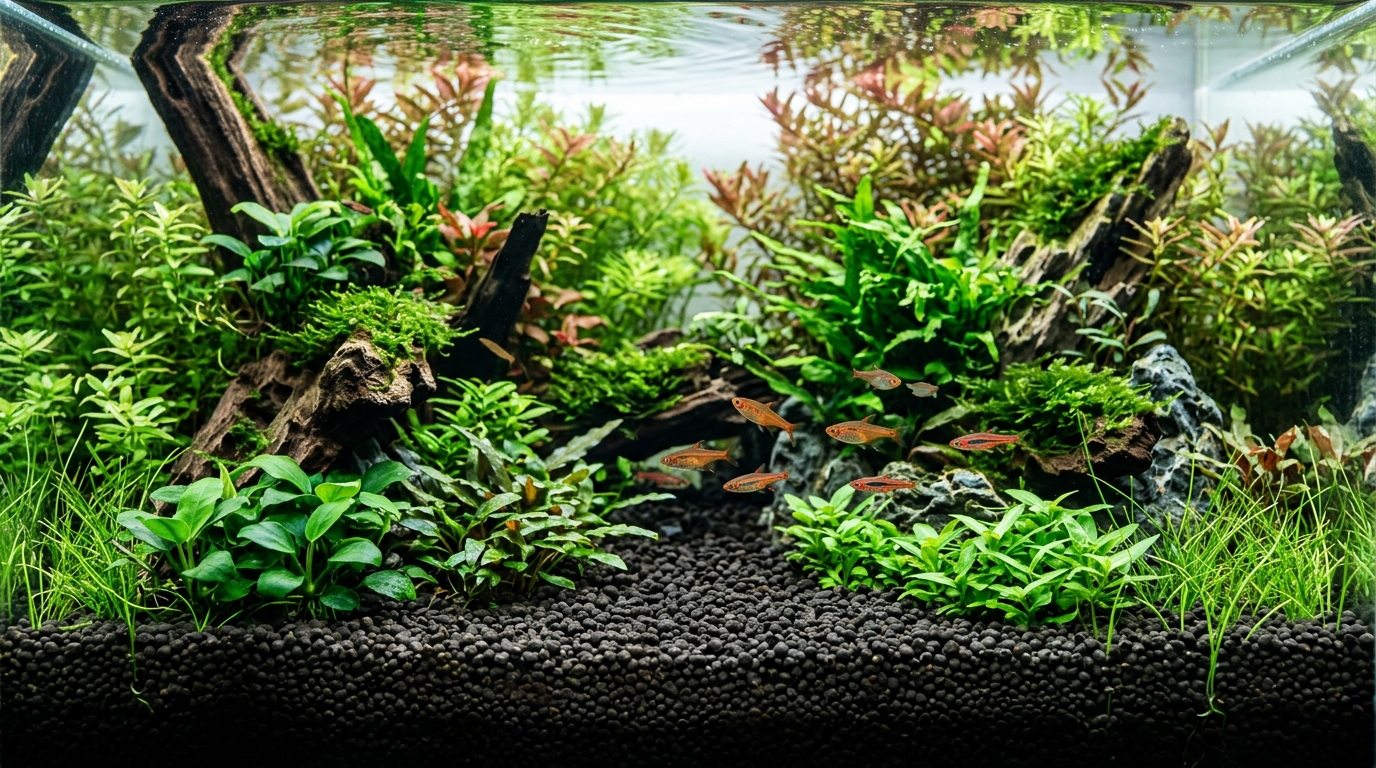
Fluval Plant and Shrimp Stratum is the bag people type into search. The 8.8 lb listing (B00JMABYUO) is the size that actually covers many 10–20 gallon footprints at a modest depth. Fluval also sells 4.4 lb and 17.6 lb bags. Fluval's copy describes a light, non-compacting porous structure, easy root penetration, support for a neutral-to-slightly-acidic range, and a claim that it will not discolor water the way some woods do.
What that means in practice: Stratum is easier to plant than Flourite. It looks like soil. It is not a permanent gravel. Over years the granules can compact and break down. You will eventually rescap or cap. That is normal for active soils.
Fluval's product name includes "shrimp" because the company markets refuge in the granules. This site does not turn that into a livestock guide. If you came here for a planted bed, treat Stratum as a mild active soil and size the bag to the footprint.
Clouding is the setup tax. Pour slowly, fill onto a plate, and run mechanical filtration. Do not stir a finished bed to "fluff" it.
Fluval Plant and Shrimp Stratum (8.8 lb)
Fluval
Porous volcanic Fluval Stratum bag sized for many 10–20 gallon planted beds, supporting a neutral-to-slightly-acidic planted range.
Before you click. Confirm Plant and Shrimp Stratum, not Bio-Stratum, and that the title still says 8.8 lb if that is the bag you meant. "Shrimp" on the bag is Fluval marketing. This desk does not write livestock guides. A 4.4 lb sibling is a half-size, not a different chemistry.
Aquasoil (Tropica as the verifiable SKU)
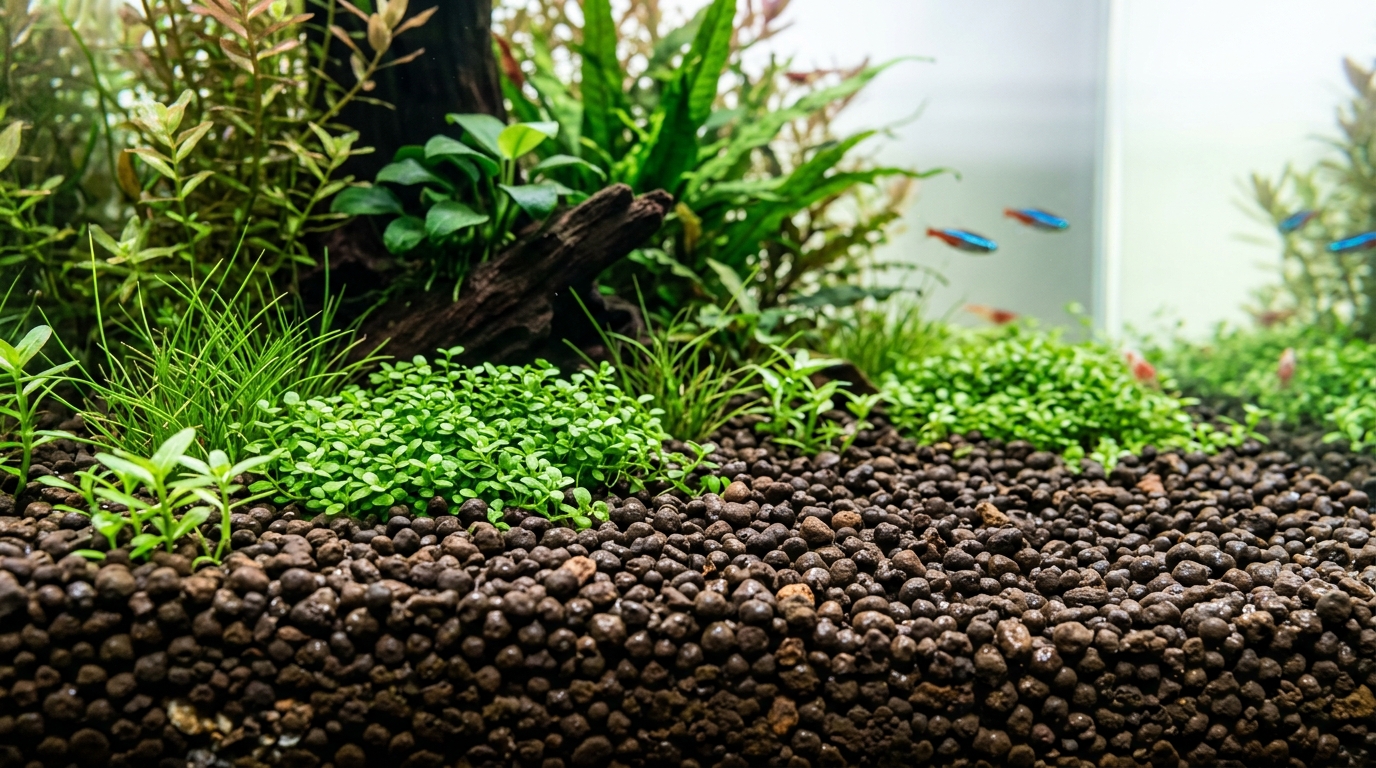
"Aquasoil" in hobby speech usually means a Japanese-style baked soil that feeds roots and buffers toward a softer, slightly acidic water. ADA Amazonia is the famous name. We do not invent an Amazonia ASIN. The US listing we can verify is Tropica Aquarium Soil 9 L (B00ZFXAZXE).
Tropica describes a complete volcanic granulate bed, 2–3 mm grain, no extra base layer required, and a first-month water-change schedule (they recommend 25–50 percent at least twice a week for four weeks) because the soil affects water chemistry. That last sentence is the difference between aquasoil and Flourite. You are buying a chemically active bed. Plan the water changes. Do not treat a new aquasoil tank like a sealed display.
Aquasoil is the pick when you want maximum plantability and you accept maintenance in month one. It is the wrong pick when you want to set gravel and forget it for a decade.
Tropica Aquarium Soil (9 L)
Tropica
Complete volcanic aquasoil from Tropica, 2–3 mm granules, intended as a full planted bed without a separate base layer.
Before you click. Confirm Tropica Aquarium Soil 9 L, not a powder-grain sibling and not a fertilizer bottle in a reused soil photo. The first-month water-change schedule is the product. If the live row dropped that language, treat the listing as changed.
Seachem Flourite
Seachem Flourite (B00025YSB0) is a fracted porous clay gravel. Seachem's own page says it is not chemically coated, will not alter pH, does not need laterite, and is good for the life of the aquarium. The 7 kg bag is the common US size.
Flourite is heavy. It is dusty until rinsed. Fine stems are harder to pin. In exchange you get a bed that does not dump a soil ammonia curve and does not ask to be replaced. You will need root tabs or water-column fertilizer because the clay is a structure, not a fertilizer bag.
Flourite Black (B0019J0ISU) is the same idea in a darker colorway if the red-brown Flourite clashes with your hardscape. The chemistry story does not change.
Seachem Flourite (7 kg / 15.4 lb)
Seachem
Stable porous clay gravel for planted tanks. Inert, does not alter pH, and is sold as a life-of-the-aquarium substrate.
Before you click. Confirm red Flourite versus Black versus sand in the title. Chemistry is the same idea; color is not a fertilizer grade. The 7 kg bag is the common US size we linked. Clay is denser than volcanic soil — bag weight is not planted volume.
Buying notes the listing will not write
Fluval's "will not discolor water" line is about the granules, not about new wood. Tannins still happen. Carbon in the filter is optional; see best filter for a planted tank and the Fluval 107 vs AquaClear 50 compare if you are choosing the box that will sit above this bed.
Tropica's extra changes in month one are the honest cost of aquasoil. Flourite's rinse-until-less-milky tax is the honest cost of inert clay. Stratum's cloud is a pour-and-fill problem, not a reason to stir the finished hill. None of those sentences appear next to the "Add to Cart" button.
A heater does not belong in this bag. Placement lives in best aquarium heater for planted tanks. Keep the tube in flow, off the granules.
Listing check
Substrate listings reuse "plant and shrimp," "aquasoil," and bag weights that are not the same as planted volume. Before you follow a plantedtankreviews-20 link on this page:
- Stratum: confirm Plant and Shrimp Stratum, not Bio-Stratum, and the bag size in the title (8.8 lb is the row we named). Fluval's 8.8 lb Plant and Shrimp bag is model 12694 on the card we verified. A 4.4 lb sibling is a half-size, not a different chemistry. "Shrimp" on the bag is marketing, not a livestock guide from this site.
- Tropica: confirm Aquarium Soil 9 L and the 2–3 mm grain, not Aquarium Soil Powder (1–2 mm) and not a fertilizer bottle in a reused soil photo. Tropica's first-month 25–50 percent change, twice a week, is the product. If the live row dropped that language, treat the listing as changed.
- Flourite: confirm original versus Red versus Black versus sand in the title. Seachem's chemistry story is the same idea across colorways; color is not a fertilizer grade. The 7 kg bag is the common US size we linked. Seachem publishes about 7,000 cm³ / 425 cu in per 7 kg bag — that is planted volume, not a "one bag per ten gallons" slogan.
Bag weight is not planted volume. Clay is denser than volcanic soil. Do the footprint math. If a marketplace row swapped a grain size or a Bio-Stratum photo onto a Stratum title, walk away. We do not invent an Amazonia ASIN to fill that hole.
| Live title should say | This page means | Walk away if |
|---|---|---|
| Fluval Plant and Shrimp Stratum 8.8 lb / 12694 | Mild active volcanic bed | Bio-Stratum, 4.4 lb, or a "bioactive powder" photo on an 8.8 lb title |
| Tropica Aquarium Soil 9 L | 2–3 mm complete aquasoil | Powder 1–2 mm, a 3 L travel bag sold as 9 L, or a depot product that wants a gravel cap |
| Seachem Flourite 7 kg | Inert clay gravel | Flourite Sand sold as the gravel ASIN, or a laterite bottle in a reused Flourite photo |
We do not paste Amazon accessory checklists. A shrimp on the bag art is not a stocking plan from this desk.
How to choose
| Priority | Pick | Why |
|---|---|---|
| Easy planting, mild active soil, easy US retail | Fluval Stratum | The volume leader; plantable; not a full Japanese aquasoil |
| Maximum soil-style growth, accept water changes | Tropica Aquarium Soil | Documented complete aquasoil with a first-month change schedule |
| Permanent bed, no pH shift from the gravel | Flourite | Inert clay; fertilize yourself |
| Cap an old soil | Inert sand or Flourite as a cap | A topic for a later guide — do not mix randomly on day one |
A 20-gallon long with a sloped 6–8 cm rear bed eats more bags than a 10-gallon cube. Do the volume math. Two 8.8 lb Stratum bags are a common 20-gallon order of magnitude; a single 9 L Tropica bag is often short for a deep scape. We will not invent a bag-count calculator from fake densities.
Setup notes that are hardware, not livestock
- Rinse inert gravel. Do not "rinse the nutrients out" of aquasoil unless the manufacturer says to — Tropica and most aquasoils are meant to go in damp, not blasted in a colander.
- Fill onto a plate or bag so the bed does not crater.
- Expect cloud. Mechanical floss is the tool, not a mystery additive.
- If you use a canister or HOB, keep the intake off the bed so you are not mining soil into the impeller. That is filter placement — see the filter guide.
The first month in hardware terms
The substrate decision does not end at the pour. The first four weeks look different by family, and every item on this list is a schedule or a piece of hardware — not livestock.
- Day zero, any family: bed in damp or rinsed per the bag, fill onto a plate, lights on a short photoperiod from the first evening — six to eight hours, not a 12-hour "sunrise." Cloud is a mechanical-filtration problem; floss is the tool.
- Weeks one to four, aquasoil: Tropica's 25–50 percent change at least twice a week is the schedule you bought. Put it on the calendar next to the filter rinse so one maintenance block covers both.
- Weeks one to four, Stratum: no published change schedule. Watch the water, not the calendar. If the tank clouds again after planting, that is planting, not the bag failing.
- Flourite, any week: the rinse happened before the fill. From then on the bed asks for fertilizer, not water changes — root tabs or a water-column product are the honest cost of inert clay.
- CO2: later. If the soil and the light are both new, build the water-change and photoperiod habits first; the needle valve belongs on a settled tank — see best aquarium CO2 kit.
- Heat: the tube goes in flow, off the granules, from day one — best aquarium heater for planted tanks.
The short version: an active soil is a four-week project with a bed at the end of it. Inert clay is a bed on day one with a fertilizer bill. Neither family is "easier" — they put the work in different months.
What we are not doing
We are not ranking substrates by "best for bettas" or "best for goldfish." Those queries are livestock. We are not recommending undergravel filter plates as a planted strategy. We are not publishing dollar-per-pound street prices; bag prices move. Check the live listing.
Related pillars
Light still decides whether a bed looks like a garden or a green film. Read best planted tank lights 2026 and the named fight Fluval Plant 3.0 vs Chihiros vs Twinstar. Pressurized CO2 changes how hard a soil can be pushed — best aquarium CO2 kit. Filter type decides whether the return is a waterfall or a hose you can aim — HOB vs canister and Fluval 107 vs AquaClear 50. A canister spray bar that mines this hill is a lily-pipe problem. A 20-gallon shopping list sits in best light and filter for a 20-gallon planted tank. Keep the heater out of the bag — best aquarium heater for planted tanks.
FAQ
Can I mix Stratum and Flourite? People do. The usual pattern is soil in the rear planting zone and inert gravel in the front. Mixing them into one slurry wastes both products. If you mix, layer on purpose.
Does Stratum lower pH? Fluval says it supports a neutral-to-slightly-acidic range. It is not a pH medication. Test water; do not dose acid because a bag photo looked tropical.
Do I rinse Fluval Stratum or Tropica Aquarium Soil? Active soils are usually meant to go in damp, not blasted in a colander. Follow the bag. Inert Flourite is the family you rinse until the water is less milky.
Fluval Stratum vs aquasoil vs Flourite — which bag is which? Stratum is the mild active volcanic bed. Tropica Aquarium Soil is the verifiable US aquasoil with a first-month water-change schedule. Flourite is inert clay that does not alter pH.
Is eco-complete in this compare? Not as a primary SKU. The three-way people search is Stratum vs aquasoil vs Flourite. Adding every inert gravel dilutes the page.
Does a Chihiros-class bar require aquasoil? No. Intensity and soil family are separate rails. A WRGB II on Flourite still needs fertilizer. A Plant 3.0 on Tropica still needs the first-month change schedule. Match the light in Fluval Plant 3.0 vs Chihiros vs Twinstar; do not buy soil to "fix" a 12-hour photoperiod.
When should I skip aquasoil? Skip Tropica if you will not run the first-month twice-weekly change schedule, or if you wanted a decade bed you never lift. Buy Flourite for a permanent inert gravel, or Stratum for a milder active bed.
How many bags does a 10-gallon cube need? One 8.8 lb Stratum, one 9 L Tropica, or one 7 kg Flourite is the usual order of magnitude at a modest depth. Do the footprint math. Do not buy a 17.6 lb sibling for later.
Can I cap Stratum or Tropica with sand? It is a later technique, not a day-one move. Sand slides, soil pokes through, and you stir a cloud. Learn on one family run as a single bed first.
Is Flourite Sand the same bag as the gravel? Same clay chemistry family, different grain. Listings swap them — check the title for the word "Sand" before you click. The ASIN this page names is the gravel.
Does an unopened bag of substrate expire? Manufacturers do not print an expiry date on these bags. Treat substrate as dry goods: sealed, dry, off a damp floor. Once a bag is open, keep it closed and dry until the next fill — do not pre-rinse and store.
Depth, slope, and bag math
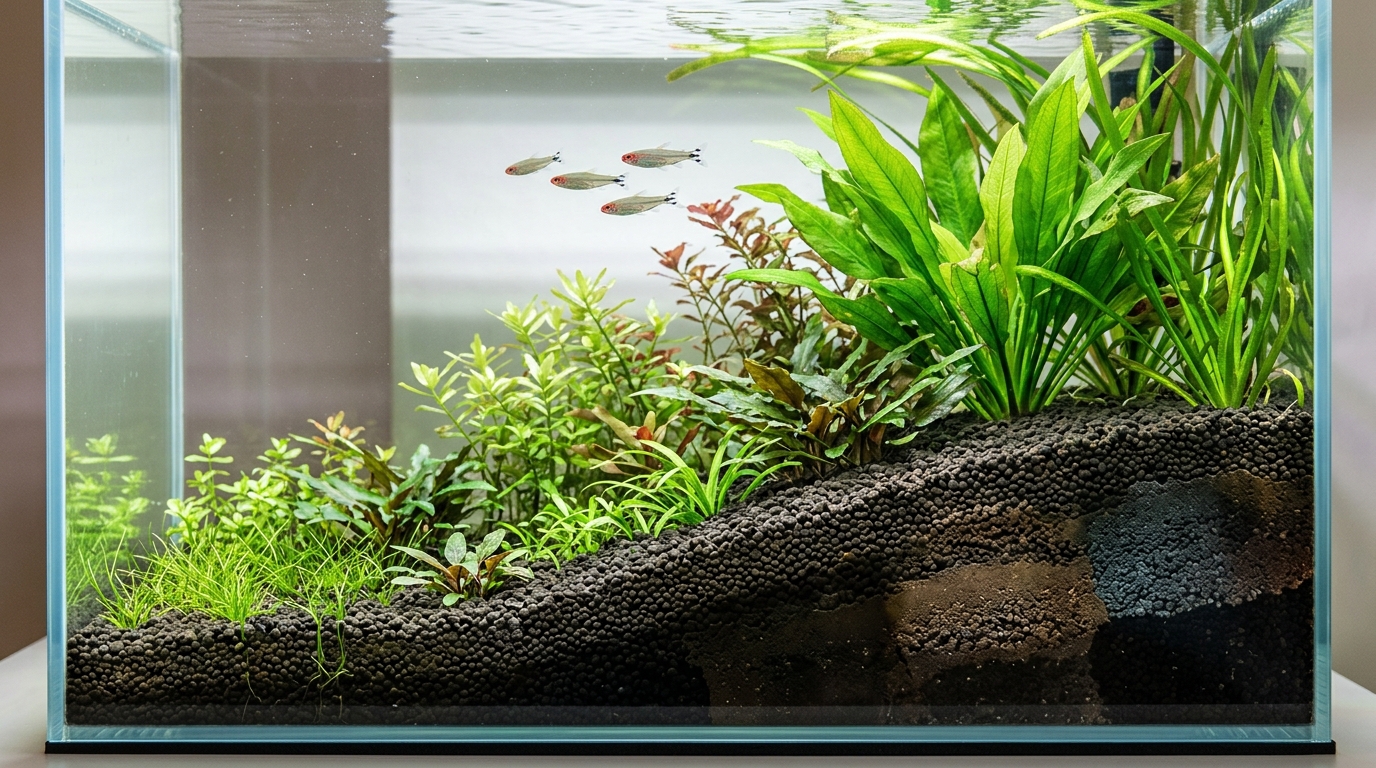
A planted bed needs enough depth for roots and not so much depth that anaerobic pockets sit under a still clay pile. Common practice is a few centimeters in the front and a slope toward the rear so the scape has perspective. That slope eats bags. A 20-gallon long with a tall rear hill can take two or three 8.8 lb Stratum bags or more than one 9 L Tropica bag. A 10-gallon cube with a flat 4 cm bed may take a single 8.8 lb bag.
Manufacturers publish bag volumes because they expect you to multiply length times width times depth. Do that in centimeters and divide by 1000 for liters. Do not invent a "one bag per ten gallons" rule. Footprints differ.
Capping soil with sand is a later technique for people who want a tidy foreground. It is easy to do badly: sand slides, soil pokes through, and you stir a cloud. If you are new, pick one family — Stratum, aquasoil, or Flourite — and run it as a single bed.
Grain size, slope, and planting feel
Grain size is the spec nobody advertises and everybody feels at planting time.
- Tropica's standard 9 L grain is 2–3 mm; the Powder sibling is 1–2 mm. Powder pins tiny foreground stems better and holds a slope worse. On a tall rear hill, standard grain is the safer buy.
- Flourite gravel versus Flourite Sand is the same split. The gravel holds slopes and shrugs at flow; the sand is for people who want a fine foreground and accept replanting fuss.
- Stratum's porous volcanic granules sit in the middle. Fluval does not publish a grain range on the listing we verified. Treat it as "light and plantable," and do not compare it pound-for-pound with dense clay.
Grain also decides what your filter can stir. Fine powder near an intake is a prefilter-sponge decision; a coarse bed shrugs at flow. If the return is a hose you aim, lily-pipe placement and grain choice are the same conversation: keep the energy off the hill, whatever the grain.
Water chemistry without YMYL
Active soils can soften water and shift pH. Tropica says so and asks for extra water changes in month one. Flourite says it will not alter pH. Stratum says it supports a mild planted range. That is substrate chemistry, not a prescription for your tap. Test your tap. If your tap is already very soft, a strong aquasoil plus more softening is a maintenance project. If your tap is hard, an inert Flourite bed will not magically make it soft.
We are not publishing target pH numbers as if they were medical set points. Plants have ranges. Hardware either buffers or it does not.
One more piece of chemistry is worth naming because "active soil" marketing leans on it: cation exchange capacity — the ability of a porous medium to hold positively charged nutrients (ammonium among them) and trade them back to plant roots. It is a real, measurable property of soils; Wikipedia's overview of cation-exchange capacity is a fair plain-language starting point. Manufacturers do not print tank-usable CEC figures on these bags, and this page will not invent them. What you can verify at retail is the behavior: Tropica publishes a water-change schedule because its soil interacts with water chemistry, and Seachem prints "will not alter pH" because Flourite does not.
Contaminants and rinsing
Inert clay ships dusty. Rinse Flourite until the water is less milky. Active soils are usually not rinsed in a colander because you are washing the reason you bought them. Follow the bag. If a retailer shipped a torn bag of Stratum, you will have dust. Mechanical filtration and patience are the tools.
Do not add random "substrate cleaner" chemicals. That is how people add a third variable and then blame the soil.
When to rescap
Active soils compact. After years the hill slumps and planting gets harder. That is the time to lift plants, replace soil, and start the water-change month again. Flourite does not ask for that on the same clock. If you hate rescape days, inert clay is the honest pick even if planting is harder on day one.
Hardscape and the bed
Rocks and wood sit on the glass or on a mesh, not on a thin soil hill you hope will hold. If a stone punches through Stratum to the glass, you will have a brown volcano every time you plant nearby. A plastic mesh or a few flat stones as a base is hardware. Glue and moss tricks are scaping technique; we mention them only to say the bed still has to be the right family.
Wood leaches tannins. Fluval claims Stratum helps with organic discoloration. That is marketing adjacent to a real phenomenon: new wood stains water. Mechanical carbon can clear stain if you want clear water. Carbon is optional on a planted tank; see the filter pillar. Stain is cosmetic, not a disease.
Retail bag confusion
Stratum has "Plant and Shrimp" on the bag and a Bio-Stratum sibling with a different SKU. This page links the 8.8 lb Plant and Shrimp Stratum we verified. Bio-Stratum is a finer, bioactive variant — a different product. Flourite has red, black, and sand versions. Chemistry is the same idea; color is not a fertilizer grade. Tropica has a powder grain for foreground plants. Powder is easier for tiny stems and harder to keep sloped. Buy the grain that matches how you plant, not a random bundle.
If a listing photo does not match the title, walk away. We do not invent ASINs to "fix" a messy marketplace row.
Bag weight is not the same as planted volume. An 8.8 lb Stratum bag and a 7 kg Flourite bag occupy different volumes because clay is denser than volcanic soil. Buy by the footprint math, not by the number on the front of the bag.
Storage, dry goods, and the garage bag
Substrate is dry goods. A sealed bag does not cycle, breathe, or spoil on a clock, and none of the manufacturers on this page print an expiry date. What ages a bag is moisture and torn plastic: an opened bag of Stratum left in a damp garage becomes a dust problem, and dust is the one thing you paid not to have.
The practical rules are short. Store bags sealed and off the floor. Rinse inert clay immediately before the fill, not weeks early — wet Flourite in a closed bucket is a bucket of mud you now own. Buy the next bag when the scape needs it, not "for later." The 17.6 lb sibling is cheaper per pound and still the wrong purchase if it sits unopened for two years next to the heater you also bought early.
Light class and the bed
Soil does not set the photoperiod. The bar does.
A mid-tier Fluval Plant 3.0 on six to eight hours is a reasonable match for any of the three families on this page. A Chihiros WRGB II on a new aquasoil bed is three new variables if you also open the needle valve on day one. That stack belongs in best planted tank lights 2026 and Fluval Plant 3.0 vs Chihiros vs Twinstar, not in a second bag of Stratum.
The hardware order is boring on purpose: decide the light length, write the hours down, then pick the bed family. An inert Flourite tank under a wide-open WRGB II still needs fertilizer and a short day. An aquasoil tank under a Plant 3.0 still needs Tropica's first-month changes. The bag does not forgive a 12-hour "pretty sunrise."
Pressurized CO2 is a later lever. If the light and the soil are both new, add gas after the water-change habit exists — best aquarium CO2 kit.
Flow versus the hill
Returns mine soil. That is a filter-aim problem, not a reason to switch brands of gravel.
- AquaClear 50 is a waterfall. Baffle it if the surface dent is ugly. It cannot take a lily-pipe kit. The named 10–20 gallon fight is Fluval 107 vs AquaClear 50.
- Fluval 107 is a hose and a spray bar. Aim along the rear glass, not at the rear hill. If the stock bar is the part you already hate, size the upgrade on best lily pipe for a planted tank — 17 mm / 16/22 mm on an 07-series AquaStop, not a 13 mm guess.
- Intake height belongs above the bed. A canister inflow sitting on Stratum is a brown volcano every time you plant nearby. Prefilter sponges catch fragments; they do not license a buried intake.
The filter pillar is the body decision. This page only asks you not to point that body at the soil.
Complete soil versus a depot you cap
"Complete substrate" on Tropica and Fluval copy means the bag is the bed. No laterite layer. No mystery base bag required. Tropica says Aquarium Soil can be used without any other type of bottom layer. Seachem says laterite is not necessary under Flourite.
That is not the same product as a nutrient depot you are told to bury under gravel. Search results mix those names. If a live row says "cover with 3–4 cm of gravel" or shows a laterite bottle on a soil title, you are no longer looking at the SKU this page named.
Capping an active soil with sand is a later technique. It is easy to do badly: sand slides, soil pokes through, and you stir a cloud. If you are new, pick one family and run it as a single bed. A plastic mesh under a heavy stone is hardware so the stone does not punch through to the glass. It is not a second soil.
20-gallon high versus 20-gallon long bag math
"20-gallon" is not one footprint. The 20-gallon stack already splits high versus long for lights. Do the same split for bags.
A common 20-gallon high is about 24 by 12 inches. Tropica's published formula is length times width times depth in centimeters, divided by 1000, in liters. At a 6 cm average depth that footprint is a little over 11 L — more than one 9 L Tropica bag. Seachem says a 7 kg Flourite bag occupies about 7,000 cm³ / 425 cu in and covers about 5 cm in a typical 10-gallon. A 20-high at 5 cm is a larger rectangle than that 10-gallon example. Plan more than one 7 kg bag.
A common 20-gallon long is about 30 inches on the long edge. Same depth, more liters. Two 8.8 lb Stratum bags are still a common order of magnitude; a single 9 L Tropica bag is usually short for a sloped rear hill.
We will not invent a Stratum density to fake a bag-count calculator. We will tell you to multiply the glass, then buy the next bag rather than stretch a slope until the glass shows through.
Root tabs are hardware, not a livestock essay
Flourite is a structure. Seachem says so. You still have to feed the bed. Root tabs or a water-column fertilizer are the honest cost of inert clay. They are not a reason to invent a fertilizer ASIN on this page, and they are not a stocking plan.
Active soils front-load some of that feeding and then fade. After a year the hill is still plantable; it is not a forever fertilizer bag. That is when people add tabs or recap. It is also when people blame the brand. The brand sold you a bed family. Fertilizer is a separate rail.
Do not bury a heater to "warm the roots." The tube stays in flow, off the granules. Heat is a room-correction problem. Soil is a planting problem. They do not share a product page.
When to skip each bag family
The how-to-choose table says which family matches a priority. This section says when to put the bag back.
| Family | Skip it when | Buy instead |
|---|---|---|
| Fluval Stratum | You want a decade bed you never lift, or you refuse a later rescape | Flourite. Inert clay is the permanent gravel. |
| Tropica Aquarium Soil | You will not run the first-month twice-weekly change schedule, or your tap is already very soft and you do not want a chemistry project | Stratum for a milder active bed, or Flourite if you want zero buffer from the gravel |
| Seachem Flourite | You need easy stem pinning on day one, or you refuse fertilizer | Stratum. Clay is a structure. You still have to feed it. |
| Any bag on this page | The light is still a 12-hour noon, or the filter return is aimed at the hill | Write the photoperiod and aim the return first. A second bag does not fix either. |
Skip a "depot plus gravel cap" listing that wants 3–4 cm of cover. That is not the complete-soil SKU this page named. Skip Bio-Stratum when you meant Plant and Shrimp Stratum 8.8 lb. Skip Flourite Sand when you meant the gravel ASIN.
Do not skip the family because a forum said every tank "needs" Amazonia. We do not invent that ASIN. Tropica is the verifiable US aquasoil. If you cannot accept Tropica's change schedule, you do not want aquasoil.
10-gallon cube bag lock-in
The 20-high versus 20-long math is already on this page. A 10-gallon cube is a different rectangle.
A common 10-gallon cube is about 12 by 12 inches, or a short 14-inch class box. It is not a 30-inch 20-long. Seachem's 7 kg Flourite example is already "about 5 cm in a typical 10-gallon." One 7 kg bag is the usual order of magnitude. One 8.8 lb Stratum bag is the usual order of magnitude at a modest flat depth. One 9 L Tropica bag is often enough, and sometimes slightly generous, on a cube that is not a rear cliff.
Do not buy a 17.6 lb Stratum sibling "for later." Unused volcanic soil sitting in a garage is not a spare part. Do not buy two 9 L Tropica bags because a 20-long shopping tab is still open. Measure the glass. Multiply length times width times depth. Then stop.
A cube also changes the other rails, not the bag chemistry. The lights pillar still wants the 15–24 inch class, not a 32W Plant 3.0. The filter pillar still wants a body you will rinse; an AquaClear 50 on a 10 is oversized unless you baffle it. The 20-gallon stack is the wrong shopping order if the tank is already a cube.
Closing
Pick the family that matches how you want to maintain the tank, not the family with the most romantic Japanese name. Then size the bags to the footprint. Then put a light on a short photoperiod so the new bed is not an algae farm. Aim the filter return along the glass, not at the hill. Heater out of the soil. That is the whole hardware story.