Best Aquarium CO2 Kit (Regulator + Solenoid)
Best aquarium CO2 regulator and kit picks: dual-stage vs single-stage, DC solenoid reliability, and what a first pressurized setup costs.
Table of Contents
Affiliate Disclosure: We may earn a commission if you purchase through our links. This does not change the price you pay. How the desk is funded: How We Make Money.
This is a research-based guide, not a hands-on test. We compare manufacturer specifications, current US retail listings, and the patterns that show up in published owner reports. We do not invent lab PAR maps, credentials, or prices. Amazon product links on this page use the Associates tag plantedtankreviews-20. You do not pay more when you use them. Retail prices move; we hedge dollar talk on purpose and tell you to check the live listing. Scope is freshwater planted-tank hardware. We do not stock livestock, review live plants as products, diagnose disease, or recommend medications.
US search interest for aquarium co2 and co2 aquarium kit is why this page exists. The product people actually need is not a yeast bottle and not a mystery "complete kit" with an unnamed regulator. It is a regulator plus a solenoid on a refillable cylinder, with a needle valve you can actually meter.
If your light is still undecided, read best planted tank lights 2026 first and the named fight Fluval Plant 3.0 vs Chihiros vs Twinstar. High light without a carbon plan is how new tanks grow film. If the bed is still gravel from a kit, read best substrate for a planted tank. A canister return that will carry an inline atomizer is a filter decision, and the glass upgrade lives on best lily pipe for a planted tank. CO2 does not replace soil, a timer, or a hose diameter.
What a kit has to include
A planted-tank CO2 kit is a stack of parts that must agree on thread, voltage, and direction of flow:
- Cylinder. North American refillable bottles use a CGA-320 valve. Paintball bottles use a different thread and need the adapter the regulator claims to include. Disposable 16-gram or 45-gram cartridges are a different thread again. The cylinder is the only part of the stack you will still own in ten years, which is why the thread and the refill path come before any gauge envy.
- Regulator. This drops cylinder pressure to a working range. Dual-stage (or multi-stage) bodies exist because a near-empty cylinder would otherwise dump gas as the first stage loses its job. The regulator is the component everything downstream inherits its stability from, so it is the worst place in the stack to save money.
- Solenoid. An electrically switched valve. A 12V DC coil is the current planted-tank default: cooler, quieter, and meant to sit on a timer. Many older AC coils run hot. If the coil has no stated voltage, the listing has told you nothing you can schedule.
- Needle valve. Fine metering after the solenoid. This is the part that turns "some gas" into "one bubble every two seconds." A cheap or gritty needle valve is the difference between a rate you set and a rate you negotiate with daily.
- Bubble counter. A water-filled window so you can see rate without guessing. It is a comparison tool for your own system, not a calibrated instrument — bubble sizes differ between counter models.
- Check valve. Stops tank water from walking back up the airline into the regulator when the solenoid closes. It is the cheapest part in the stack and the one whose absence kills the most expensive one.
- Diffuser or inline atomizer. The last hardware choice: ceramic disc in the tank, or a fitting on a canister return. Which one is legal depends entirely on your filter type.
If a retail bundle omits the solenoid, you do not have a kit you can schedule. If it omits the check valve, you will buy one the week water reaches the gauge. If it says "kit" and the regulator has no model number, skip it. This site will not invent a SKU to fill that hole.
How we compared kits
We scored regulator-plus-solenoid kits on:
- Documented stages. Dual-stage or multi-stage construction versus a single gauge and hope.
- Solenoid voltage. 12V DC with a timer story versus an unnamed AC coil.
- Thread honesty. CGA-320, paintball, and cartridge compatibility written on the listing — including what the kit will not fit.
- Service reality. Needle valve, bubble counter, spare O-rings, and whether a current US ASIN exists.
- Gauge readability. Two gauges you can read from a crouch beat one coin-sized dial you cannot. The Pro Series puts a pair of 1.6-inch dials on the body for exactly this reason.
- Metering claims that survive contact. A published low-end bubble rate is a claim you can check the day the box arrives. "Fine adjustment" is not.
We did not invent dissolution rates or "ppm charts." If a manufacturer does not publish a working-pressure band, we do not pretend we measured one. We also do not publish street prices. Dual-stage solenoid kits often live in the low-to-mid hundreds; compact minis often sit below that. Check the live listing.
FZONE Pro Series (dual-stage, dual block)
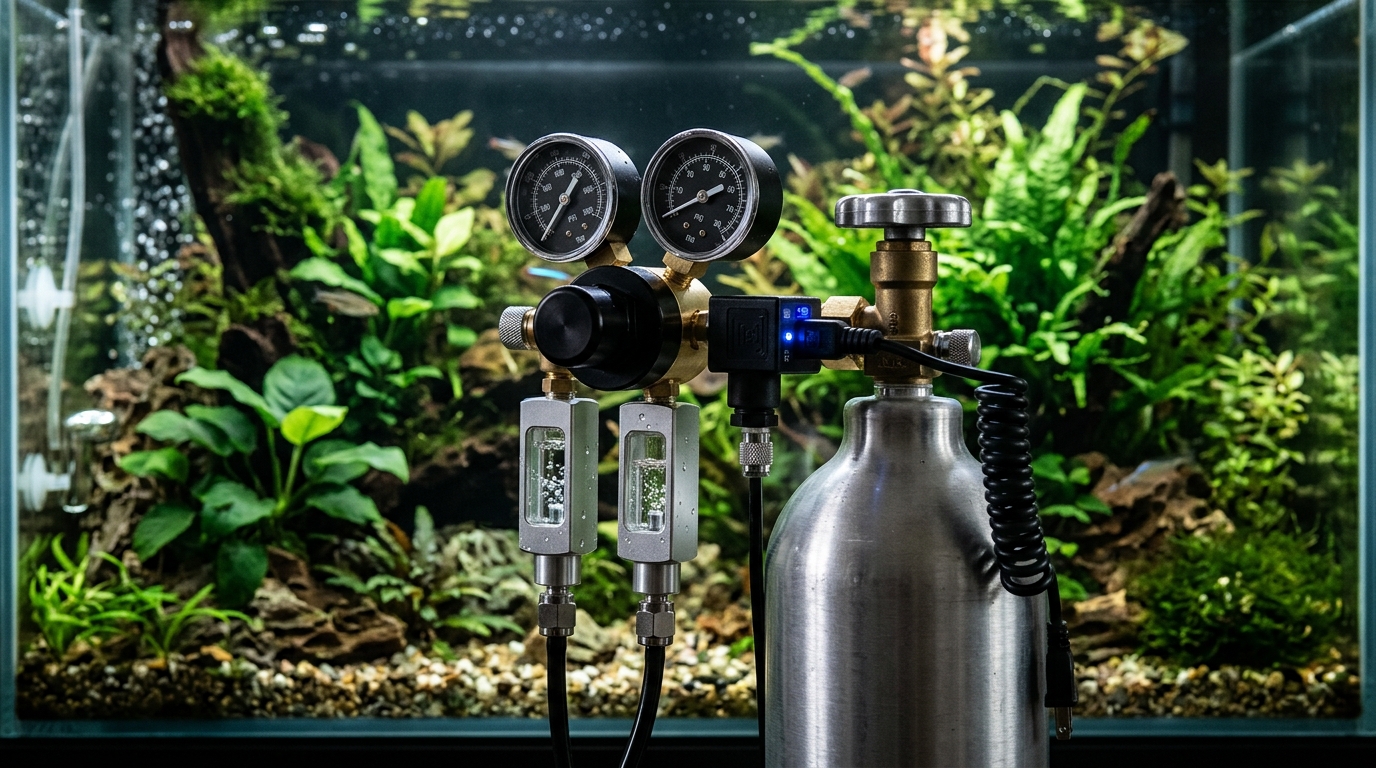
The FZONE Pro Series (B0838KXK5D) is the named regulator-plus-solenoid kit this pillar can actually verify. FZONE's listing describes dual-stage construction, adjustable output from 0–65 PSI, a safety relief around 100 PSI, two independent manifold blocks with needle valves, a 12V DC solenoid, and CGA-320 compatibility for North American cylinders. Installation tools ship with the body.
What you are buying is not a decorative bubble. You are buying stable working pressure as the cylinder empties, a solenoid you can put on a timer, and two needle-valve paths if you later run a second tank or want a spare block. Dual-stage is the feature people mean when they say they do not want an end-of-tank dump.
Where the Pro Series is the wrong default: you wanted a tiny body on a paintball bottle, or you wanted a single-tank mini and you do not need a second manifold. The Mini Series exists for that footprint.
Where the Pro Series is the right default: you are stepping off disposable cartridges, you can store a CGA-320 cylinder, and you want the solenoid and needle valve to be part of one current listing instead of a parts scavenger hunt.
FZONE Pro Series dual-stage CO2 regulator
FZONE
Dual-stage aquarium CO2 regulator with 12V DC solenoid, dual manifold blocks, needle valves, and bubble counters for CGA320 cylinders.
Before you click. Confirm dual-stage language, two manifold blocks, a 12V DC solenoid, and CGA-320 in the current bullet list. A paintball-only photo on a Pro row is the wrong object. Dual-stage in a title is not a thread. Installation tools in the box do not replace a check valve if that part is listed separately.
FZONE Mini Series V3.0
The FZONE Mini Series V3.0 (B08P5FKQDT) is the compact sibling. The listing describes multi-stage decompression, a 0–60 PSI working band, a 12V DC solenoid, a precision needle valve, and a bubble counter with a check-valve function. It claims compatibility with paintball tanks, CGA-320 cylinders, and 5/8-inch UNF disposable cartridges. It also says, in plain language, that Fluval 45-gram 3/8-inch cartridges do not fit.
That last sentence is why we like this listing: it tells you what it will not thread. Mystery kits never do.
The Mini is the pick when cabinet space is ugly, the tank is a 10–20 gallon, and you want one needle valve rather than a dual manifold. It is the wrong pick when you already know you will run two tanks off one cylinder, or when you want the larger Pro Series gauges and blocks in a cabinet you can actually see.
Disposable cartridges will run a Mini. They also cost more per gram of gas than a refillable bottle. Treat cartridges as a weekend test, not a five-year plan.
FZONE Mini Series V3.0 CO2 regulator
FZONE
Compact multi-stage aquarium CO2 regulator with 12V DC solenoid, needle valve, and bubble counter; CGA320, paintball, and 5/8-inch UNF cartridge compatible.
Before you click. Confirm the Mini / V3.0 name and the "will not fit Fluval 45-gram 3/8-inch cartridges" line. If that exclusion disappeared, the listing may have changed generation. Compatibility with paintball, CGA-320, and 5/8-inch UNF cartridges is not the same as fitting every Fluval cartridge on the shelf.
Buying notes the listing will not write
A solenoid without a timer plug is just a warm coil. Buy the timer the same day and put it on the same clock family as the light — best planted tank lights 2026 and the named light compare. Overnight leftover carbon plus leftover photons is an algae recipe, not a growth recipe.
Spare CGA-320 washers and CO2-rated airline are cheaper than a second regulator. Do not "fix" a hiss by opening the needle valve. A ceramic disc in the product photo is not proof the check valve is in the box.
If the tank is still a 20-gallon shopping order, read best light and filter for a 20-gallon planted tank before you buy a cylinder you cannot store.
Listing check
CO2 kit titles on Amazon stack "dual stage," "complete kit," and "solenoid" onto bodies that may omit a check valve or a documented thread. Before you follow a plantedtankreviews-20 link on this page:
- FZONE Pro (B0838KXK5D / 2020pro): confirm dual-stage language, two independent manifold blocks, a 12V DC solenoid, 0–65 PSI working band, a ~100 PSI relief, and CGA-320 in the current bullet list. A paintball-only photo on a Pro row is the wrong object. Dual-stage in a title is not a thread.
- FZONE Mini V3.0 (B08P5FKQDT / FZ-1011): confirm the Mini / V3.0 name, the 0–60 PSI working band, and the "will not fit Fluval 45-gram 3/8-inch cartridges" line. Compatibility with paintball, CGA-320, and 5/8-inch UNF cartridges is not the same as fitting every Fluval cartridge on the shelf. If that exclusion disappeared, the listing may have changed generation.
- Skip unnamed "complete CO2 kit" bundles whose regulator has no model. If you cannot search the body, you cannot replace an O-ring.
| Live title should say | This page means | Walk away if |
|---|---|---|
| FZONE Pro Series dual-stage, dual block, 12V DC, CGA-320 | Two needle-valve paths on a refillable North American bottle | A single-gauge paintball body, an AC-coil photo, or a "complete kit" with no model |
| FZONE Mini Series V3.0, 12V DC, paintball + CGA-320 + 5/8-inch UNF | One needle valve, documented "no Fluval 45 g 3/8-inch" | A 3/8-inch Fluval cartridge bundle, or a yeast bottle in a reused Mini photo |
| Named regulator + solenoid + needle valve | The kit this pillar is about | "Complete CO2 kit" with no body name, no thread, and a ceramic disc as the only proof |
We do not paste the Amazon accessories checklist. A ceramic disc in the photo is not proof the check valve is in the box. Installation tools in the Pro box do not replace a CGA-320 washer you can reseat. Buy the named body, then add the missing airline part.
Dual-stage versus single-stage, without folklore
A CO2 cylinder starts at a high stored pressure. A regulator's first job is to bring that down. A single-stage body does the drop once. As the cylinder empties, that remaining pressure changes, and cheap single-stage kits can drift or dump. A dual-stage body does the drop in two rooms: the first stage takes the ugly high-pressure swing, the second stage holds a working pressure the needle valve can live with.
None of this is aquarium folklore — it is generic compressed-gas regulator behavior. The single-stage versus two-stage tradeoff, and the end-of-tank stability argument, is described in any gas-industry reference; see the pressure regulator overview on Wikipedia for the version with no fish in it. Planted-tank sellers did not invent the physics; they inherited it.
That is the hardware reason dual-stage kits show up in planted-tank shopping, not a livestock-safety sermon. End-of-tank dump is a regulator design problem. Buy the design that addresses it, then still watch the high-pressure gauge so you refill before the cylinder is a rattle.
FZONE's Mini marketing says "dual" and "triple" in the same breath depending on which sentence you read. Owner write-ups often describe the first stage as non-adjustable. We are not going to re-litigate the naming. The practical test is: does working pressure stay usable as the bottle empties, and does the solenoid close cleanly on a timer? If a listing cannot say what thread it fits, it has already failed a more basic test.
What we are not recommending
- Yeast and sugar bottles. They are science-fair carbon, not a regulator kit. Rate wanders. They do not have a solenoid schedule.
- Unnamed "complete CO2 kit" bundles whose regulator has no model. If you cannot search the body, you cannot replace an O-ring.
- Paintball-only mystery regulators that do not list a CGA-320 path if you later want a real cylinder.
- Fluval 45-gram cartridges on a Mini. The Mini listing says they do not fit. Believe it.
- Running CO2 24 hours because a forum said plants "use it at night." Put the solenoid on the light's clock family.
- Skipping the check valve. Water in a regulator is a repair, not a personality.
- pH controllers as first hardware. A probe, a calibration schedule, and a dosing loop are a later project, not a starter kit. The solenoid-on-a-timer stack is the default for a reason.
Diffuser versus inline atomizer
A ceramic diffuser sits in the tank and makes a mist. You can see it. You can also see it clog with biofilm, which is why people boil or replace discs. Place it on the opposite side from a hang-on-back outflow so the stream carries mist across the glass instead of blasting it into the weir. That is flow geometry. See best filter for a planted tank for HOB versus canister context.
An inline atomizer sits on a canister return. The mist is harder to see and easier to forget. It also wants tubing that can take the extra fitting without a leak behind the cabinet. If you run an AquaClear 50, you do not have a canister return; you have a waterfall. Buy a ceramic disc. If you run a Fluval 107, you can choose either, but you still need a check valve before the regulator.
We do not publish "mist size equals success" charts. If the drop checker is readable and the needle valve holds a rate, the disc is doing its job. If the disc is white with scale, clean or replace it before you buy a second regulator.
Drop checkers are hardware, not medical devices
A drop checker is a glass or acrylic reservoir with an indicator solution that sits in the tank water. It lags. It is a trend tool, not a laboratory. Use it to see whether yesterday's needle-valve change actually moved the color, not to invent a treatment protocol.
This site will not tell you a target color as if it were a prescription. We will tell you to place the checker where you can see it from a normal chair, away from a CO2 blast that paints a fake local reading. If you cannot see it, you will not use it.
Buy a second checker only if you run a second tank. One readable trend per tank is the whole job. A wall of checkers is a wall of opinions that all lag by the same hour.
Timer, photoperiod, and the light you already bought
CO2 without a schedule is just a leak you paid for. Pair the solenoid with the same timer idea as the light:
- Start gas around lights-on, or slightly before if you already know your checker lags.
- Stop gas before lights-off so leftover carbon is not sitting under leftover photons.
- Write the hours down. Six to eight hours is a common planted-tank starting band for both light and gas.
Retailer guides land in the same place — Aquarium Co-Op's planted-tank writing frames CO2 as a decision the light schedule drives, not a bottle you add first and think about later. We agree with the ordering.
If you bought a Fluval Plant 3.0 or a Chihiros bar with an app schedule, do not let the LED run a 14-hour "pretty sunrise" while the solenoid runs eight hours of confusion. Match the clocks. Details live in the lights pillar and the named light compare.
Tuning the needle valve without folklore
The needle valve is a rate knob, and the internet treats it like a lottery ticket. Three habits keep it boring:
- One change per day. Turn, log, sleep. If you change the rate twice before the checker has even lagged into its new reading, you have learned nothing about either change.
- Do not import someone else's bubbles-per-second. Bubble counters differ in chamber and bore, so a "bubble" is not a standard unit between models. Your own counter and your own notebook are the only calibration that transfers.
- Trends beat snapshots. A checker color you can see from a chair, logged against the bubble count that produced it, is a usable record. A color photo from someone else's tank is not.
If the rate you set at dinner is not the rate you see at breakfast, that is a hardware conversation — see slow failures — not a reason to spin the knob farther.
Cylinder sizing and cabinet reality
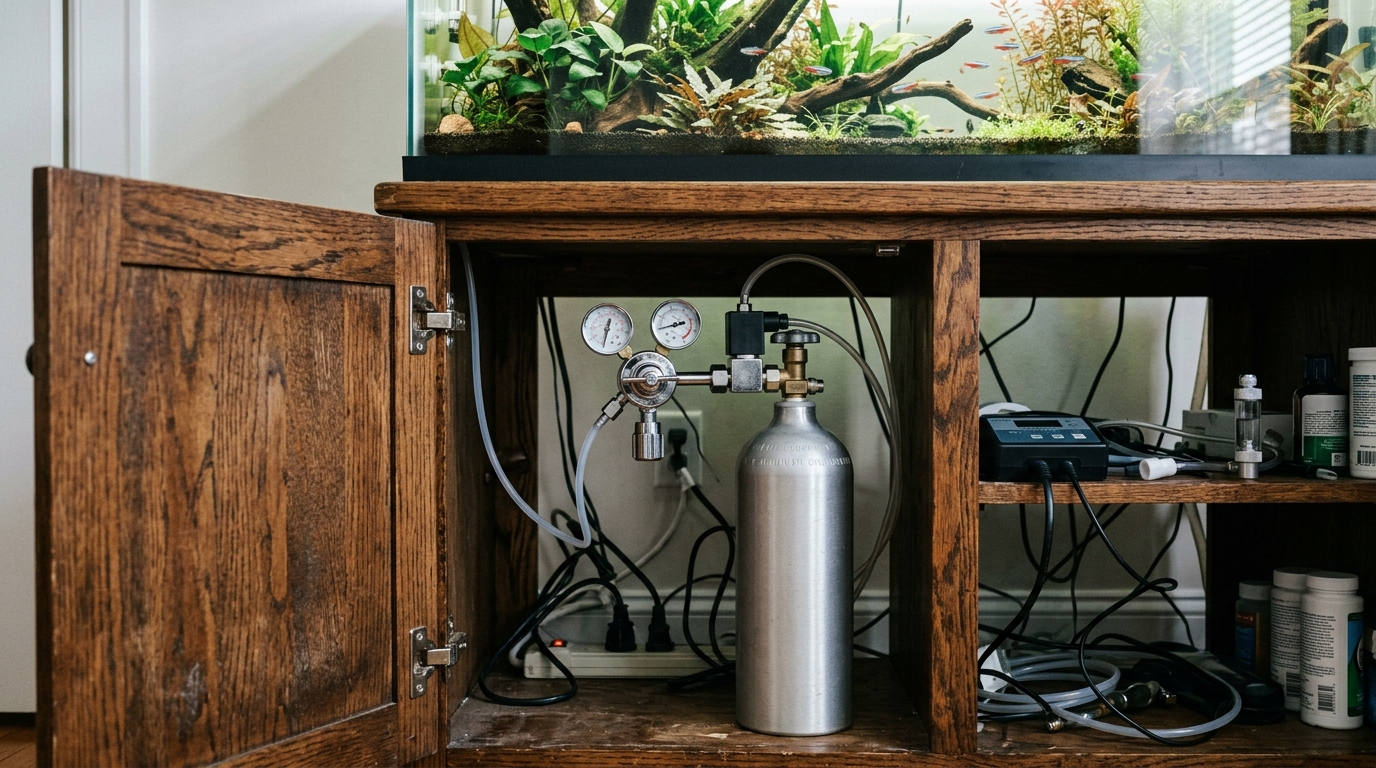
A 20-gallon planted tank with a modest stem group usually sits comfortably on a 2.5-pound or 5-pound cylinder if you are not blasting mist for hours. A 20-pound cylinder starts to make sense when you run a larger tank, a high-demand carpet, or you simply dislike swapping bottles. The regulator does not change; the cylinder does. Confirm the CGA-320 thread before you buy a new bottle, and confirm that your local shop can hydro-test or exchange it.
Keep a cheap notebook of bubble rate and drop-checker color after each change. You do not need scientific precision. You need a log that tells you whether last week's reading was the same reading you see after a weekend away. If you travel, a timer that starts CO2 with the light and ends it before lights-off is the hardware, not a livestock-health protocol. Leftover carbon plus leftover light is how many planted tanks go sideways.
Do not buy a second regulator "just in case" until your first one is leak-tight. Leak-chasing two systems at once is how people empty cylinders in a week and blame the brand. Buy extra O-rings, extra airline, and a spare needle-valve knob if those parts are sold separately. That is cheaper than a second body.
Cylinder handling: upright, strapped, and away from heat
A CO2 cylinder is industrial hardware that happens to live behind your tank. Three habits keep it boring:
- Stand it upright and secure it. A cylinder that tips can snap the regulator body at the CGA-320 nut or shear a gauge. Strap it to a stand leg or the wall with a clamp or bracket meant for the bottle diameter. Securing compressed-gas cylinders upright is standard industrial practice, not hobby folklore — OSHA's compressed-gases guidance tells factories the same thing we are telling you.
- Keep it away from heat. Not against the heater's side of the cabinet, not in a sun beam through the tank glass. Stored pressure rises with temperature; a warm bottle is a variable you did not buy.
- Move it like it is heavy. Valve closed, regulator removed if the trip is more than across the room, never dragged by the valve handwheel. A 20-pound bottle is a hand-truck object, and the hydro-test station is the one place a dropped bottle ends the conversation.
The cylinder handwheel is not a daily control either. It gets touched at cylinder changes and storage. Everything daily belongs to the timer and the needle valve — see three valves, two gauges.
Leak checks that do not require folklore
After you thread the regulator, brush a little soapy water on the CGA-320 joint and the needle-valve block. Bubbles that grow are leaks. Tighten or reseat the washer. Do not "fix" a hiss by opening the needle valve and hoping the room smell goes away.
Airline that yellows and hardens will crack at the barb. Replace it. CO2-rated tubing exists because ordinary airline can be porous. If your bubble rate climbs with no needle-valve change, look for a crack before you look for a new brand.
When you change a cylinder, close the needle valve, close the cylinder, bleed residual pressure the way the manual describes, then swap. A live regulator on a half-threaded bottle is how gauges get ruined.
Re-check the joints after any cylinder swap, not just the first one. A washer that sealed perfectly on the last bottle can sit crooked on the next one, and the soap test takes thirty seconds.
Slow failures: creep, drift, and the gauge that will not sit still
Not every failure hisses. Three quiet ones show up on pressurized planted tanks:
- Creep. The working-pressure gauge rises slowly while no gas is being drawn. That is the regulator's seat leaking past itself, a documented failure mode of compressed-gas regulators in general — the same pressure regulator overview covers it without mentioning fish. Creep does not fix itself. It is a service-the-body situation.
- Rate drift. The bubble count set at dinner is different at breakfast with nobody touching the needle valve. Could be seat wear in the needle valve, could be a porous line. Soap-test the joints, inspect the airline, and only then consider the valve.
- Ghost bubbles. The counter keeps producing bubbles well after the solenoid closes. Gas is still moving somewhere it should not be. Find it with soapy water before it finds your cylinder budget.
A falling working-pressure reading with a still-full bottle is still a leak or a setting — see three valves, two gauges. None of these are brand verdicts; they are wear items on any body in this category. The fix is a part, not a philosophy.
Which kit for which tank
| Situation | Research pick | Why |
|---|---|---|
| 10–20 gallon, one tank, tight cabinet | FZONE Mini V3.0 | One needle valve, documented threads, DC solenoid |
| One or two tanks, CGA-320 cylinder, want dual blocks | FZONE Pro Series | Dual-stage, two manifolds, 0–65 PSI band |
| Still choosing light and filter for a 20-gallon | Read the 20-gallon stack first | CO2 is a later lever |
| No refill shop within a reasonable drive | Do not start with mystery cartridges as a "kit" | Plan the cylinder path or wait |
A 20-gallon long with a Chihiros-class bar is a better CO2 candidate than a 10-gallon with a hygger on six hours. Match intensity to carbon. Do not buy a Pro Series because a forum said every tank "needs" it.
One cylinder, two tanks: what the second manifold is for
The Pro Series' second manifold block is not decoration. It exists because two tanks off one cylinder is a normal end state for people who catch the hobby.
The rule is one needle valve per tank. Two tanks at different water depths, with different hose runs and different disc resistances, will not share a single metered stream fairly — the path of least resistance gets all the gas. Meter each branch separately and give each branch its own bubble counter so each tank has a readable rate. That is exactly the configuration the Pro's dual independent blocks describe.
What not to do: tee the line before the needle valve and hope. Hope is not a manifold. A brass tee from a hardware drawer has no metering at all, and the tank with the shorter hose wins.
The Mini can technically feed a tee too. Do not. If you know a second tank is coming, the dual-block body is the cheaper purchase than a second complete kit.
Common setup mistakes
Solenoid unplugged "for now." Then the cylinder empties into a closed tank overnight. Plug the solenoid into the timer on day one.
Diffuser on the same corner as the HOB intake. Mist goes into the filter instead of across the bed. Move the disc.
Needle valve as the on/off switch. That is what the solenoid is for. The needle valve is a rate knob. If you close it every night by hand, you will drift the rate and never know why the checker changed.
Aquasoil month-one plus max mist plus a 12-hour photoperiod. That is three new variables. Set the substrate water-change habit first, then add gas.
Heater touching the diffuser. Local heat plus a ceramic disc is a weird microclimate and a broken suction cup. See heater placement.
Cylinder standing free in the cabinet. It worked until the day the cabinet door met the gauges. Strap the bottle — see cylinder handling.
Quick Verdict
Rating: 8.3 / 10
The FZONE Pro Series is the named dual-stage regulator kit this guide can actually verify — documented dual-stage construction, a 12V DC solenoid you can put on the light's timer, CGA-320 compatibility, two needle-valve manifold blocks, and readable 1.6-inch gauges — scored honestly, with paintball-only builds and single-tank minis explicitly routed to the Mini Series instead.
FAQ
Can I run CO2 without a canister filter? Yes. A hang-on-back tank uses a ceramic diffuser and flow from the waterfall. The Fluval 107 vs AquaClear 50 compare is about filtration, not a CO2 prerequisite.
Do I need a pH controller? No. A solenoid on a timer plus a drop checker is the default hardware stack. Controllers are a later project with their own probe-calibration chores. We are not selling a medical loop.
Is a paintball bottle enough? It can be, if the regulator lists a paintball adapter and you can refill it. Capacity is the limit, not morality. Plan the refill path.
What thread does a planted-tank CO2 regulator use? North American refillable bottles use CGA-320. Paintball bottles need the adapter the listing claims. Many 80–90 g cartridges are 5/8-inch UNF. Fluval 45-gram 3/8-inch cartridges do not fit the FZONE Mini V3.0.
Can I run an inline atomizer on a hang-on-back filter? No. An inline atomizer wants a canister return. AquaClear 50 is a waterfall. Buy a ceramic disc, or change filter type first — best filter for a planted tank.
Do I need CO2 if I buy a Fluval Plant 3.0? No. Plant 3.0 is a mid-tier bar. Match intensity to carbon, not the other way around. A WRGB II without a carbon plan is the algae kit. Details live in Fluval Plant 3.0 vs Chihiros vs Twinstar.
When should I skip a pressurized kit? Skip it on a short mid-tier photoperiod, with no refill path, or when the bar is the wrong length. Gas will not fix a 22W Plant 3.0 on a 20-long.
Does CO2 fix a light that is too short? No. Buy the matching length first. The 20-gallon stack is the length page. This page is the regulator.
Why won't you list a yeast kit as a starter? Because this page is about regulator-plus-solenoid kits. Yeast is a different product with a different failure mode.
What about CO2Art or other pro brands? They exist. We only affiliate-link current ASINs we can verify. If a listing is messy or regional, we omit the link rather than invent an ID.
Where do I refill a CGA-320 cylinder? A welding-supply, beverage-gas, or hydro shop that will fill or exchange a CGA-320 valve — not a pet-store impulse lane. Confirm the shop will take your bottle before you buy the regulator. Paintball fills are a different queue.
Ceramic diffuser or inline atomizer on day one? Ceramic disc if the filter is a hang-on-back or you want a part you can see. Inline atomizer only on a canister return, in the same hose family as the stock bar or lily. AquaClear 50 cannot take an inline fitting.
Three valves, two gauges
A planted-tank CO2 stack has three things that close, and people use the wrong one as the switch.
- Cylinder valve. Opens the bottle. Close it when you change cylinders or store the tank. It is not a daily rate knob.
- Solenoid. The electrical on/off. This is the part that belongs on the light's timer family. FZONE's Pro and Mini listings both describe a 12V DC coil meant to sit on that clock.
- Needle valve. The rate knob. FZONE's Pro copy claims a low end around one bubble every three seconds. That is a metering claim, not a medical set point. Leave it alone once the checker trend is readable.
The Pro Series puts two 1.6-inch gauges on the body: one for cylinder (stored) pressure, one for working pressure. Read them as two rooms. The high-pressure gauge tells you when to refill. The working-pressure gauge tells you whether the second stage is still holding a band the needle valve can live with. A falling working-pressure reading with a still-full bottle is a leak or a setting, not a reason to buy a second brand.
Do not "fix" a hiss by opening the needle valve. Do not use the needle valve as the nightly off switch. That is how rates drift and drop checkers become folklore.
Thread family, without folklore
Thread is the first listing check that mystery kits fail.
| What you have | Thread the listing must name | Named body on this page |
|---|---|---|
| North American refillable cylinder | CGA-320 | FZONE Pro (native story) or Mini (adapter story) |
| Paintball bottle | Paintball adapter in the bullets | Mini lists it. Pro is the CGA-320 default. |
| 80–90 g disposable cartridge | 5/8-inch UNF | Mini says most of those fit. Treat cartridges as a weekend test. |
| Fluval 45-gram cartridge | 3/8-inch | Mini says it does not fit. Believe it. Do not invent an adapter ASIN. |
CGA-320 is a Compressed Gas Association connection standard — the same valve family a welding shop or beverage-gas supplier handles every workday. That is the whole reason the refill lane exists at those counters and not at a pet store.
CGA-320 washers crush. Buy extras the same day. A live regulator on a half-threaded bottle is how gauges get ruined. When you swap a cylinder: close the needle valve, close the cylinder, bleed residual pressure the way the manual describes, then swap.
Paintball bottles are smaller. That is a refill-path problem, not a morality problem. If your local shop will not fill paintball, do not start there.
Light class decides whether a cylinder is on the table
CO2 is optional on a mid-tier bar. It is a better candidate on a high-output bar.
- Fluval Plant 3.0 on six to eight hours with easy plants may never need a cylinder. That is a scheduling win, not a failure.
- Chihiros WRGB II wide open on a new bed is the algae kit if carbon and fertilizer are still "later." Match the clocks. The named fight is Fluval Plant 3.0 vs Chihiros vs Twinstar.
- A 20-gallon high versus a 20-gallon long changes cabinet space, not the regulator body. Measure the stand before you buy a 20-pound bottle you cannot store. The shopping order lives in best light and filter for a 20-gallon planted tank.
Do not buy a Pro Series because a forum said every tank "needs" dual blocks. Buy dual blocks when you have two needle-valve paths to use, or when you want the larger gauges in a cabinet you can see.
When to skip the cylinder
Pressurized CO2 is optional hardware. Skip the cart when:
| Situation | Why skip |
|---|---|
| Hygger or Fluval Plant 3.0 on six to eight hours | Mid-tier light. Carbon is not the first limit. |
| No refill shop you will actually drive to | Cartridges are a weekend test, not a kit. |
| 22W Plant 3.0 sitting on a 20-long | Wrong bar. Buy the 32W length first — 20-gallon stack. Gas will not invent coverage. |
| New aquasoil plus a new high-output bar | Three variables. Set the substrate water-change habit first. |
| You wanted an inline atomizer but the filter is AquaClear 50 | Buy a ceramic disc, or change type on Fluval 107 vs AquaClear 50. Do not buy a 107 only so a kit photo looks high-tech. |
A Chihiros WRGB II wide open on a new bed is the case against skipping. Match the clocks. The named fight is Fluval Plant 3.0 vs Chihiros vs Twinstar.
Do not buy gas to fix a light-length mistake
A 22W Plant 3.0 on a 30-inch 20-long is short. A regulator will not stretch photons to the short ends. Measure the glass. Buy the 32W class or a 60 cm Chihiros. Length tables live in best planted tank lights 2026.
CO2 is a later lever on a bar that already covers the bed. It is not a coverage patch. The 20-gallon stack exists so that length mistake dies before the cylinder arrives.
Water-change day: three plugs
Three cords on a planted cabinet are not one switch.
- Heater. Unplug if the water line will drop below the minimum mark. Details in heater placement.
- Solenoid. Stays on the light's timer family unless the diffuser is about to sit in air. Do not close the needle valve as the off switch.
- Light. The photoperiod does not pause because you moved gravel.
If you also run a Fluval 107, shut the AquaStop valves the way the manual describes. If you later added lily pipes, wet-fit the hose on the way back. Dry glass chips. A hanging lily during a drain is a lever on a suction cup.
The 20-high versus 20-long split changes how far you reach, not which valve you close. A cube stand on a 20-high is why the Mini regulator exists. A 20-long has more floor and a longer hose. Measure the cabinet before the bottle, not after.
Lily pipe, spray bar, and where the mist goes
Filter type picks the last fitting.
- AquaClear 50 is a waterfall. You get a ceramic disc in the tank. You do not get an inline atomizer. Keep the HOB, or change type on Fluval 107 vs AquaClear 50.
- Fluval 107 can take a ceramic disc or an inline atomizer on the return. The stock spray bar can carry current across the glass if you aim it. If you replace that bar, hose diameter is the purchase — best lily pipe for a planted tank. A 17 mm / 16/22 mm set matches the 07-series AquaStop. A 13 mm set does not, unless you also bought a documented reducer.
- Inflow versus disc. Do not mount the ceramic disc in the same corner as the canister intake so the filter eats the mist. Move one of them. That is flow geometry, not a second regulator.
An inline atomizer wants tubing that can take the extra fitting without a leak behind the cabinet. Adding a third hose diameter to that cabinet is how leaks multiply. Keep the atomizer in the same family as the lily or the stock hose.
What a "complete kit" still leaves on the table
Retail bundles love the word complete. The body still leaves chores:
- A timer for the solenoid. Buy it the same day. Put it on the same clock family as the light.
- A check valve if the bubble counter is not already that part. Arrow toward the tank. Water walking back into a regulator is a repair.
- CO2-rated airline. Ordinary vinyl can be porous. If bubble rate climbs with no needle-valve change, look for a crack before you look for a new brand.
- A drop checker you can see from a chair. It lags. It is a trend tool.
- A refill path. Hydro-test or exchange for CGA-320. Paintball fill if that is the bottle. No shop within a reasonable drive means you do not have a kit yet.
- A strap or bracket for the cylinder. An upright, secured bottle is the cheapest insurance in the stack.
- Cabinet space for the cylinder and the heater cord. They do not share a tangled strip you cannot reach.
Aquasoil month-one plus max mist plus a 12-hour photoperiod is still three new variables. Set the substrate water-change habit first. Then add gas. Then stop shopping for a second regulator.
Refill logistics: exchange, hydro, and the empty-gauge trigger
Thread is already on this page. This section is the trip you take after the regulator is leak-tight.
Confirm the shop before you buy the body. A CGA-320 refill is a welding-supply, beverage-gas, or hydro shop, not a pet-store impulse lane. Call and ask whether they fill planted-tank bottles, exchange them, or both. Paintball fills are a different queue — a field or a specialty shop that already handles that valve. We will not invent a shop name or a dollar-per-pound price.
Exchange versus refill. Exchange swaps your bottle for theirs. You leave with a valve and a hydro date that belong to the shop's fleet. Refill keeps your bottle. You own the hydro stamp. Out-of-date cylinders get refused. Read the date before you drive.
Empty-gauge trigger, not a weaker mist. The Pro Series high-pressure gauge tells you when to refill. A weaker ceramic mist is often a clogged disc, not an empty bottle. Clean or replace the disc before you blame the shop. A falling working-pressure reading with a still-full bottle is still a leak or a setting — see three valves, two gauges.
Spare washer in the glove box. CGA-320 washers crush. Buy extras the same day as the regulator. A live body on a half-threaded bottle is how gauges get ruined.
2.5 lb versus 5 lb versus 20 lb is trip frequency. The regulator does not change. A cube stand on a 10 or a 20-high is why the Mini exists. A 20-long has more floor and a longer hose. A 20-pound bottle you cannot store is not a savings plan. Measure the cabinet, then pick the cylinder you will actually haul.
Cartridges have no refill path. That is the point. Treat 5/8-inch UNF 80–90 g cartridges as a weekend test. Fluval 45-gram 3/8-inch cartridges still do not fit the Mini. Do not invent an adapter ASIN to "fix" that sentence.
This is not the when-to-skip table. That table decides whether a cylinder belongs on the cart. This section assumes you already bought one and need a path that is not a mystery cartridge forever.
Solenoid and timer: day-one mistakes
The solenoid is the electrical switch. Day one is when people wire it like a phone charger.
| Mistake | What actually happened | Fix |
|---|---|---|
| Solenoid on a dead USB outlet | The coil never opened. The needle valve sat there looking innocent. | Plug the 12V brick into a live switched outlet on the same strip as the light. |
| App sunrise on the bar, wall timer on the coil, two different clocks | Gas and photons drift apart by a week | Write both hours on one note. Match the family. Six to eight hours is the common start band. |
| Needle valve used as the nightly off switch | Rate drifts. The drop checker becomes folklore. | Leave the needle valve alone. The solenoid is the switch. |
| Solenoid unplugged "for now" | The cylinder empties into a closed tank overnight | Timer on day one, before you open the cylinder valve. |
| Click never heard at lights-on | Dead outlet, dead brick, or the timer is in the wrong program | Test the click before you open the bottle. |
Do not close the cylinder valve every night as a safety ritual if the solenoid is already on the timer. That is how people forget to open it in the morning and then open the needle valve to "catch up."
What a blackout does and does not do
Power cuts are a hardware question, and the answers are mostly dull in a good way.
The gas stops on its own. A de-energized solenoid is a closed solenoid — that is the normal design in this category. When the strip goes dark, the coil stops holding the valve open and the cylinder stops feeding the tank. The bottle does not empty into a blackout.
The clocks are what drift. A mechanical dial timer keeps roughly its position but can slip; a digital timer usually resumes its program; an app-scheduled light picks up its own curve wherever it wakes up. After any outage longer than a blip, re-match the two clocks before the next lights-on instead of trusting both to have survived identically.
Check the counter, not the knob. At the first lights-on after an outage, glance at the bubble counter. If nobody touched the needle valve, the rate should be where you left it. If it moved, that is a hardware conversation, not a reason to re-tune by feel.
The heater is the cord that matters. A filter and a solenoid tolerate an outage fine; a heater that runs dry after a partial drain does not. Unplug habits for water-change day live in heater placement.
Diffuser vs inline atomizer: decision tree
The earlier diffuser versus inline note is the product idea. This tree picks the fitting from the filter and the tank nickname.
| Filter and tank | Ceramic disc | Inline atomizer |
|---|---|---|
| AquaClear 50, any size | Yes. Place it opposite the waterfall so the stream carries mist across the glass. | No. There is no canister return. Keep the HOB or change type on Fluval 107 vs AquaClear 50. |
| Fluval 107 + stock spray bar | Yes. Keep the disc away from the intake. | Yes, if the fitting matches the hose ID. |
| Fluval 107 + 17 mm lily | Yes | Yes, in the same 16/22 mm family. Do not add a third diameter. |
| 10-gallon cube | Disc is visible and serviceable. | Inline is extra cabinet clutter for little gain on a cube. |
| 20-high, cube stand | Disc. The Mini regulator already eats the stand. | Inline only if the 107 is already the plan and the cabinet door still closes. |
| 20-long + 107 | Either. Longer hose is the leak risk. | Same hose family as the stock bar or the lily. |
Check valve still sits before the regulator. Arrow toward the tank. A disc you can see will clog; boil or replace it before you buy a second body. An inline you cannot see will clog too — you just notice later.
Do not buy a 107 only so an atomizer photo looks high-tech. That is a filter decision, not a regulator upgrade.
Related hardware
CO2 is one rail. Light still decides whether the gas is used or wasted — best planted tank lights 2026 and Fluval Plant 3.0 vs Chihiros vs Twinstar. Filter flow places the mist — best filter for a planted tank and Fluval 107 vs AquaClear 50. A canister return you can aim, or a lily-pipe set that will carry an inline atomizer, lives on best lily pipe for a planted tank. A 20-gallon shopping order lives in best light and filter for a 20-gallon planted tank. Keep the heater in that flow, off the cylinder tangle — best aquarium heater for planted tanks. The bed still has to be a planted family, not kit gravel — best substrate for a planted tank.
A closing checklist
- Confirm you have a refill path for a CGA-320 or paintball cylinder.
- Buy a named regulator-plus-solenoid body (Pro Series or Mini), not an unnamed bundle.
- Add a check valve if the bubble counter is not already that part.
- Put the solenoid on the light's timer family.
- Strap the cylinder upright, away from heat.
- Place the diffuser in flow you can see.
- Log bubble rate. Change one thing at a time.
That is the whole kit. Everything else is algae troubleshooting, and algae troubleshooting starts with the clock, not a second brand of regulator.
Before the kit, the honest question is whether your tank needs injected CO2 at all: Do Planted Tanks Need CO2? What Actually Changes With and Without.